I. The Writer’s Life
Certain people tend to be good listeners. Writers, for example.
The writer might hear how, when you swing the fence shut, it clicks and bounces back to click again, trapped in the latch.
A stranger at a party might tell the writer how, filled with jealousy as a child, she carried her infant sister to a field and briefly, mere minutes, left her there.
The writer will know that art can be found in this story.
The writer can hear this story and overhear at the same time across the room a voice say, I love you. You know that, don’t you? I always have.
And more. The writer, hearing these two things, connects them, as if hearing another story from another time, a baby placed in a caulked wicker basket among a shock of reeds, or a bloodied cloak and a brother sold into slavery.
I love you. You know that, don’t you? I always have.
#
The good writer might be like a mother, for she can hear a child crying down the street and know it is the cry that shakes loose on its own. It is not the cry that holds. Mothers also see. They see the lie before it is spoken. And when a mother hears the lie, she hears the world that she has been working to keep at bay. It is like a war against the waves.
This writer-mother sees and hears. This means the writer-mother witnesses. Another word for a witness is martyr. Police detectives, investigative journalists, and other writers are witnesses and martyrs. Writers, like detectives, must look at things that others may prefer to ignore. They must choose to do this, to unearth stories in an effort to understand, and this choice is a virtue, this seeing.
In his essay “Three Crime Stories” (“Trois récits de faits divers”) Emmanuel Carrère narrates shocking acts committed by seemingly ordinary people. By writing about these acts, he makes a choice to serve as witness to their stories, not just to see what Vivian Gornick might call the “situation” of each individual crime. The situation has already been captured in so many news reports. One of the crimes is an attempted matricide. The son’s guilt is certain, but he goes free. The woman had given the son up for adoption and, twenty years later, after seeking out his mother and reuniting, he becomes conflicted about what the reunion means to him and what it says about his place in the world. After an uneventful lunch together, the son stabs his mother several times. Miraculously, she survives and forgives him, dropping all charges and telling the judge that she alone is responsible for the attack. The details of the crime can be reported easily enough, but the “story,” what Gornick defines as “the emotional preoccupations” of the writer (in a memoir) or in this case the emotional forces behind both victim and perpetrator, requires more. The situation provides a frame, but it does not show us the lives in the frame. This story-work must be done by the writer-mother-witness, as detective, to understand.
The detective gives us another element of listening and seeing in a story. The hunch. Sometimes a detective has a hunch, which is an idea that defies logic, as we see in Carrère’s essay, where the son’s rage and regret and his mother’s forgiveness and love seem to defy expectation. As a writer, Carrère must have felt that something was missing, that the situation required a story to be understood.
As good listeners, the writer-mother-witness must also have hunches; the writer must, in essence, hear themselves too. A stray image always arrives in the human mind at some point, a landscape, perhaps, or a story. An object or a dream. Maybe something feels like it is missing and work must be done to find an answer. It is not for the writer-mother-witness to put this image aside, this “hunch,” or this feeling that more exists behind a simple report. It is not for art to follow only an outline. It is for art to defy systems.
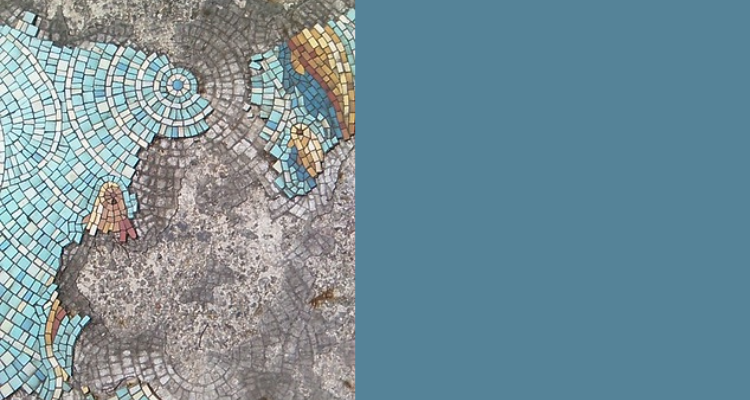
“Croydon Mosaic” by Kevan is licensed under CC BY 2.0.
II. The Frame as a Way of Speaking
Eventually, the writer-mother-witness will speak: they will be compelled to create or help or explain that which they’ve seen, heard, witnessed. This can happen in many ways.
Here is one way.
Noam Chomsky once wrote, “There is no longest sentence,” because he wanted to show that any sentence could be made longer than the longest sentence by embedding it in another sentence. There is a name for this that sounds like a secret marriage: discrete infinity. He also said it is true of all human languages, this type of infinity. There is another grammar name for it, which we call recursion.
Here is an example of me using recursion, and attempting to use it in a way that holds meaning in the mind.
The writer wrote the book that changed the people who built the army that killed the people who fled to the land where they built a temple that honored the souls who fell in that war that changed the idea that war is good.
That was not infinite. But with patience, Chomsky says, I could keep going forever.
Conclusion: To speak is to stack. To tell a story is to speak.
A style of story may be to stack—not sentences, but stories, one after another. In the recursion sentence above, where I embedded one idea within another idea, so many of those nouns hold a separate story stacked on top of them, another story within the story of that word. In this sentence, the people were changed by a book. Whatever was in that book made them want to become mighty. They built an army out of fear, perhaps, or some understandable need for security. But things went horribly wrong and they used their army to kill people. To become aggressors.
And on it goes.
Art is not always clear; intentions are vague, motivations missing, symbols dense and fecund. Art is not always clarity in the way a manual must be clear. Stack the stories; allow them even the most threadbare connection. This is composing. But composing begins to bother me as I get older. It implies arranging toward clarity more and more. Maybe even perfection.
Instead, we might imagine a style called “extreme showing.” For instance, it may be the case that I want to describe a character, and this means describing who they are inside. I will tell the reader that this person is somber. Fine. But the writing teacher in me says “show us” how this character is somber, or why they are somber; do not tell us. And I continue to struggle with how to show my audience. The idea of storytelling may help me. I need a story from my character, a story of somberness.
A new character means a new story, a small story, stacking it on the other characters’ stories, as all the stories move toward something, or—as I will show you next with a threadbare connection—the characters move within something. A framework. And this might be a way to conceive an artistic endeavor like plot, and challenge the traditional Western, white, male linearity.
#
What is a framework?
Let’s imagine a few literary scenarios. These are what we call frames, and framing a stack of stories is necessary for keeping our infinity discrete, for containing our recursion.
Imagine a royal room in a high tower inside a castle where the kingdom is under siege. Barbarians fight at the gates while, behind the walls, up in this tower, old men sit by the barricaded door while women and children gather around a hearth. The battles below are so pitched the sounds of metal-on-metal dance upwards to the inner sanctum. Beyond the pale, people that they know and love die; some scream or cry for their wives or mothers. To remain in the room, to refrain from running outside to join them in death, the people in this tower tell stories. Lots and lots of stories.
The battle, the war, frames them and their stories. We barely need to look at the chaos at the gates. We know it’s there. We need only look at the room in the tower in the castle.
First a mother tells the children a story of another battle from a different time, of course, because she can’t tell the story of this current battle outside. It isn’t finished yet. The war story that she chooses is filled with despair because victory is unlikely, but it ends with a surprising win, a kingdom’s survival.
This story is about hope. Everyone connects it, whether she intended it or not, to the story happening outside.
Then an old man tells a tale of another war—a damning affair for both sides, a slaughterhouse. It is clear from the beginning that no main character will live. They will each die in their own way, fighting for what they believe.
This story is for preparation. And the connection is made to what is happening outside, each story important to the frame. In fact, even if a story seems random, the mind connects to the frame, finding meaning where there wasn’t meaning or a connection. The old man could say, “Once this girl named Mary had this little lamb that followed her everywhere.” He could sing the whole nursery rhyme. And suddenly, everyone in the room would be lambs; and all their Marys would be fighting for them outside.
There are examples of this in both fiction and nonfiction. In the Decameron, the writer Giovanni Bocaccio introduces the fictional story of seven women and three men who isolate themselves from the Black Death in a villa near 14th century Florence. That’s the frame. Black Death outside, the cast of characters inside. Unlike the stories of war while war takes place outside, as in the first example, these stories don’t always explicitly comment on the frame, which is the plague, the reason for their isolation in the villa. Can a frame merely serve as an excuse to create a mosaic? A beautiful pattern within a larger idea?
Acclaimed nature writer Barry Lopez’s essay “Fourteen Aspects of Power” offers power as a frame, specifically the many ways power appears in nature: the venom of a nine-foot long mamba snake, the shotgun pressed to his abdomen after being pulled over as a suspect for a crime, a pile of three thousand empty shoes in a display case at the Holocaust museum in Berlin, a wolf waking from being tranquilized. These reflections are meant to give the reader a sense of the forces that subdue us, as well as the forces we use on others.
To know enough to tell such stories, the writer-mother-witness must listen, as I said, and must know a common terror, a frame within which the writer can share what they’ve heard, seen, or witnessed. It can be a war or a plague or a pilgrimage, but Lopez shows that there is a great diversity of other human experiences that allow us to stack the stories within them, to create a discrete infinity. Nature in his case. Grief, in others. Jonathan Tropper’s novel, This is Where I Leave You, presents us with three angry siblings who are forced by their mother to sit shiva, the Jewish tradition of mourning for seven days. In a much more focused frame, shiva serves as the cup within which the stories will be poured, and the taste of each story will take on a small flavor of the cup. In Rachel Cohen’s hybrid memoir, Austen Years: A Memoir in Five Novels, the situation or frame is the death of her father and the birth of her children. Cohen comes to understand her grief and her motherhood through a near-obsessive reading and re-reading of Austen’s work for nearly a decade. The novels serve as companion and cipher, where her readings and interpretations create a mosaic of overlapping stories through which father, child, and Austen make and re-make Rachel Cohen.
The list goes on. What is grief but a frame within which we place our stories to understand, to share, to heal?
Often, all the stories a writer-mother-witness generates for their readers within a frame are grounded in writing craft. Framing stories leads to other qualities of good writing: an improved distance between writer and narrator, symbolism, juxtaposition, and so on. And it refuses the old clunky craft work of following a simple diagram, an outline, to get started.
The frame helps to stop the stories from becoming chaos. It stops them from becoming a devolution of thought. My Aunt Moll hears one word and interrupts, cutting off the speaker to begin a voluble stream of consciousness. It initially seems like order but then words she has spoken lead her to interrupt herself again, to continue around a maddening calliope on a never-ending loop. Rarely does her story highlight something she has heard a real person say in the last twenty years, going against being a writer-mother-witness and serving as a sign, maybe, that she has no frame to help contemplate a stream of ideas. This is not a mosaic. It’s an unraveling.
Therefore it is not enough to stack the stories maniacally, to speak only to luxuriate in the sensuous act of making sounds. The greatest sign of a mosaic is the evidence of creative intent, the imperfect but loving attention that longs to turn disorder into a line. A thought. Even that word mosaic is telling. A mosaic can be a variety of stones placed cunningly together to form a picture, or no picture at all. A mosaic can be that: a beautiful pattern. Its imperfections add to the gestalt power of the artist’s composition…because the “threat to harmony,” as philosopher and art critic J.F. Martel tells us in his treatise Reclaiming Art in the Age of Artifice, is what adds to the beauty.
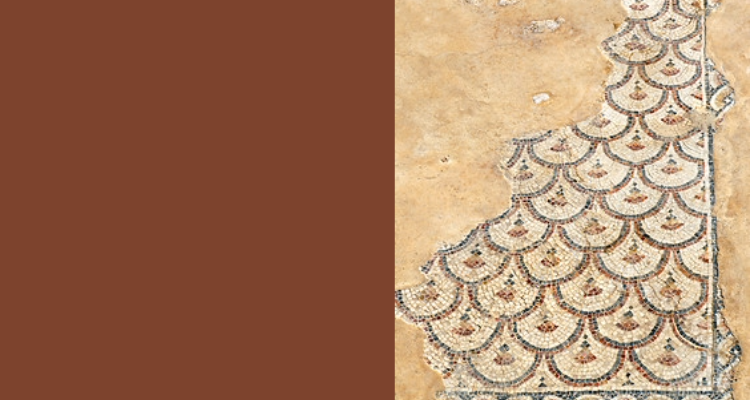
“Israel-04854 – Palace Mosaics” by archer10 (Dennis) is licensed under CC BY-SA 2.0.
III. Craft as Life
Don’t worry now. I’m nearing the end. The number three is still a powerful organizer. From listening and seeing in the beginning to speaking and writing in the second part, I will end by saying that this is my own aesthetic sensibility, for writing and paying attention to the world. I notice frames all the time. And I know that my craft is connected to how I live, and I even notice a sort of morality in it.
I listen so that I might speak. I listen to the stories stacked. The frame comes from my own life, usually, which means offering a tragedy, a struggle, or obstacle. Then I can make my mosaic within it. The thing about using frames from your life is that there is an audience connected to you right away. If you’ve experienced it, then chances are good that someone else has experienced the frame.
Once I have a frame, I do not limit myself. Instead, I let the flood of stories come rushing in, a pattern, a manifold. Discrete infinity makes us see a collection of lives, for example, imagining different perspectives and consciousnesses. This approach can bring forth the uncanny unexpected that I didn’t realize existed inside me. Returning again to J.F. Martel’s words, “Mere appearances become apparitions connecting us to other levels of reality.”
–Joshua Thusat is an essayist and fiction writer. He is also a professor of literature and writing in the Chicagoland area. His work has been featured in Five South Journal, Spectrum Literary Journal, Doubleback Review, and Change Seven Magazine, among other publications. He was able to afford his graduate degree in literature from Bowling Green State University by delivering ice across northern Ohio, in towns with beautiful names like Vermilion. Sometimes he misses it and thinks that being an ice man could very well be the frame for his entire life.
Cover image “Arizona Sunset – Fractal Mosaic” by qthomasbower is licensed under CC BY-SA 2.0.


Pingback:Redemption Through Re-Narration – true.