An Interview with Kate Crane, Author of What Ever Happened to Eddy Crane?
Sometimes the algorithm works the way it’s supposed to. On an evening social media scroll in early January, Facebook threw Kate Crane into my feed, “My first book comes out three months from today. I started this journey in summer 2007. Surreal.” The Harper Collins link previewed the cover of her forthcoming memoir; familiar looking rowhomes and stoops flanking a dimly lit city street. The blurb at the top caught my eye, from David Simon, who’s known for his work on the hit show The Wire, “Beautifully crafted. Crane stirred the embers of a Baltimore cold case everyone else was willing to forget – her father’s.”
BALTIMORE!
It’s where I’m from. My hometown. It’s a place I love and loathe. It’s a place I left. It’s a place I return to…again and again and again, reckoning with my past and the loss of my own mother to murder. I study and map its changes, for better and worse. I keep poking at it, prodding it for answers until it threatens to bite me again. I retreat, nurse my wounds, but can never let it go.
Memoirs that chronicle the piled-up losses and grief that come from the trauma of a murdered parent, and the subsequent years of piecing a life and identity back together are extremely niche. I discover maybe one every two years. When I do, I scour the pages for something familiar, for overlapping experiences, heavy feelings that took me too long to name or describe, and a structure sturdy enough to hold the weight of it all. Despite Baltimore having what I consider a lively art and literary scene, I’ve yet to come across a recent true-crime memoir based in Charm City. And as interesting as are the spent lives of residents here, if you’ve ever lingered over its haunted cobblestone, you quickly learn Baltimore is a main character.
Having grown up twenty minutes south of where Kate did in Baltimore County, I’m grateful that she was open to discussing her debut memoir with me, as we explored how our respective relationships with Baltimore shape our approaches to craft. Our conversation has been edited for conciseness and clarity.
An important aspect of memoir writing is the reflection, and I was curious if this pursuit changed her relationship to Baltimore, and if so, how?
Kate: If you spend a lot of time working on anything, no matter what, your relationship with it will change. That’s the essence of spending a lot of time with something or someone — inevitably, the relationship will change. I wanted to write a love letter to Baltimore, as much as to my dad, and I do feel like I did that to the best of my ability. Maybe there’s a way in which I felt I had unfinished business with Baltimore, and this book settles it.
In the epilogue, Kate mentions that had her father lived, she wondered if she would have ever left Baltimore. She viewed Baltimore as a sea monster, with this perfect quote from a friend, “…You know the abyss. You’re from Baltimore.” The way that Kate writes about Baltimore made me feel that it was this force that pressed in on her life, rather than just a backdrop for her story, and I hoped she could expand on that decision, and how she approached that.
Kate: Baltimore was a character in the book. Just like my old housemate Harold, the VW mechanic, or my dad, or any other human in my book. I had to strive to treat Baltimore in a multi-dimensional way. That means trying to capture the essence of our relationship. Baltimore was a force pressing in on me. I think if I didn’t love Baltimore, I would’ve written it as scenery. But I wanted to treat it with as much care and writerly scrutiny as I did any human being in the book. Essential to the nature of the relationship is the fact of that inward pressure.
How do you feel so far about how your memoir has been received and your overall experience?
Kate: I feel good about how it’s being received, and it’s also an emotional roller coaster. I’m accustomed to working full-time as well as working on a book. Right now I’m in a tech layoff, like so many thousands of others, and I no longer have this book to work on in the same way that I did for all those years. So, there’s a sense of being adrift. Yet I did what I set out to do with the book. Anytime I’m having a bad ride on the roller coaster, I remember that. It’s not 90% the book I wanted or 96%. It’s exactly the book I wanted. That is the bottom line, no matter if I’m feeling great or worried about what I’m doing with my life. Knowing that I did what I set out to do is a good feeling.
How did you know when you were done? Did you have any moments where you thought, I should have included that, or wrote it this way, and of course, the more you write, your craft tends to improve a little bit. Maybe after time, you understand more of the story or your craft has improved.
Kate: I definitely have those. But the second draft was a year and a half of intense work on top of a full-time job. We did two rounds of edits after I turned in the first draft in January 2023. I’d absorb the big picture of where my editor wanted me to go and run with that, saving his specific comments for reference. After I turned in that second draft in November 2024, I was up working until 6, 7, 8 a.m. for the better part of a year, continuing to add and revise until August 2025. At that point, I knew I did everything I could. It’s inevitable that, later, you’re going to think, “I should have included such-and-such thing.” But I’m still digging out from apartment chaos and areas of my life that of necessity were completely on hold. I could not have worked any harder without winding up in the hospital. That is a statement of fact. Health issues did arise from how hard I pushed: I messed myself up in ways I still go to physical therapy for, 18 months after turning in draft two. When I find myself wishing I’d included a certain anecdote or place, I try to shrug it off and say, “Yep, this feeling was inevitable.” Maybe I’ll use it in a novel or a short story.
So often in media centered in Baltimore, especially when tied to crime, we are fed its grit, grime, and underbelly, which isn’t what Kate gave us at all, even though she could have. After reading What Ever Happened to Eddy Crane, I came away with a sense Baltimore is a source of conflicted affection for her. I asked Kate what advice she would give to memoirists writing about places they feel nostalgic for even when it’s sharpened by crime. Does one lens distort the other?
Kate: The love for Baltimore is not conflicted — it’s a 10/10 absolute. Baltimore itself for me is definitely complicated. I don’t know that I can move back, although I do look at real estate listings a couple times a year. But the love for Baltimore is not conflicted at all. As for my particular take on Baltimore, growing up a white kid in the county is of course fundamentally going to define my experience and approach. I know artists who have grown up in affluent places who have taken on a gritty persona that does not align with reality. That doesn’t appeal to me. Even if it did, I feel like people would be able to smell the inauthenticity of it. But it’s beside the point because I had no interest.
About nostalgia: Look for the scenes and details that best serve as the bones of your book. Scenes and details that are so true to who you are and the story you’re telling that nostalgia and crime are almost irrelevant. I found mine through meditation and patience.
Also, I loathe the true-crime genre. It corrodes empathy and has rendered many of its fans incapable of distinguishing fact from fiction, particularly how the ethics of fiction diverge from the ethics of telling a story about real people who died violent deaths and whose loved ones may still be around and suffering. Every murder is just a podcast away from being snackable entertainment! So a couple things intersect: I have a big, hostile problem with the true-crime genre and I am a white kid from the county. Whatever I wrote was going to be rooted in, either consciously or unconsciously, the fact that I did not grow up on Fayette and Monroe, à la David Simon’s book The Corner. That’s not my Baltimore.
One of my North Stars was, “How do I tell this story in a way that only I can?” I’m hearing the book described as gritty, and that’s fine. It’s a neat word. But as a writer who’s done a lot of music criticism, I know there are words that people reach for as a crutch because they can’t quite put a finger on something. I think that that’s what the gritty thing is here. With every scene I aimed to build toward a story only I could tell that, piece by piece, would create a compelling narrative. To me, details like the geriatric mutt who ate string beans from the vine and walked all over Baltimore, or the hair-raising phone call in a house straight out of Dr. Who, are just as marvelous as anything crime-y in my book.
I knew what she meant. I didn’t get the gritty vibe either. The feeling I got was the exact opposite, certainly a more flowery version of the Baltimore I was accustomed to, which is simply authentic and genuine to a childhood there, but also a version that enveloped all the intricacies of what Baltimore is. How do you explain a place like Baltimore County to an audience that is only familiar with that harder David Simon version of Baltimore City?
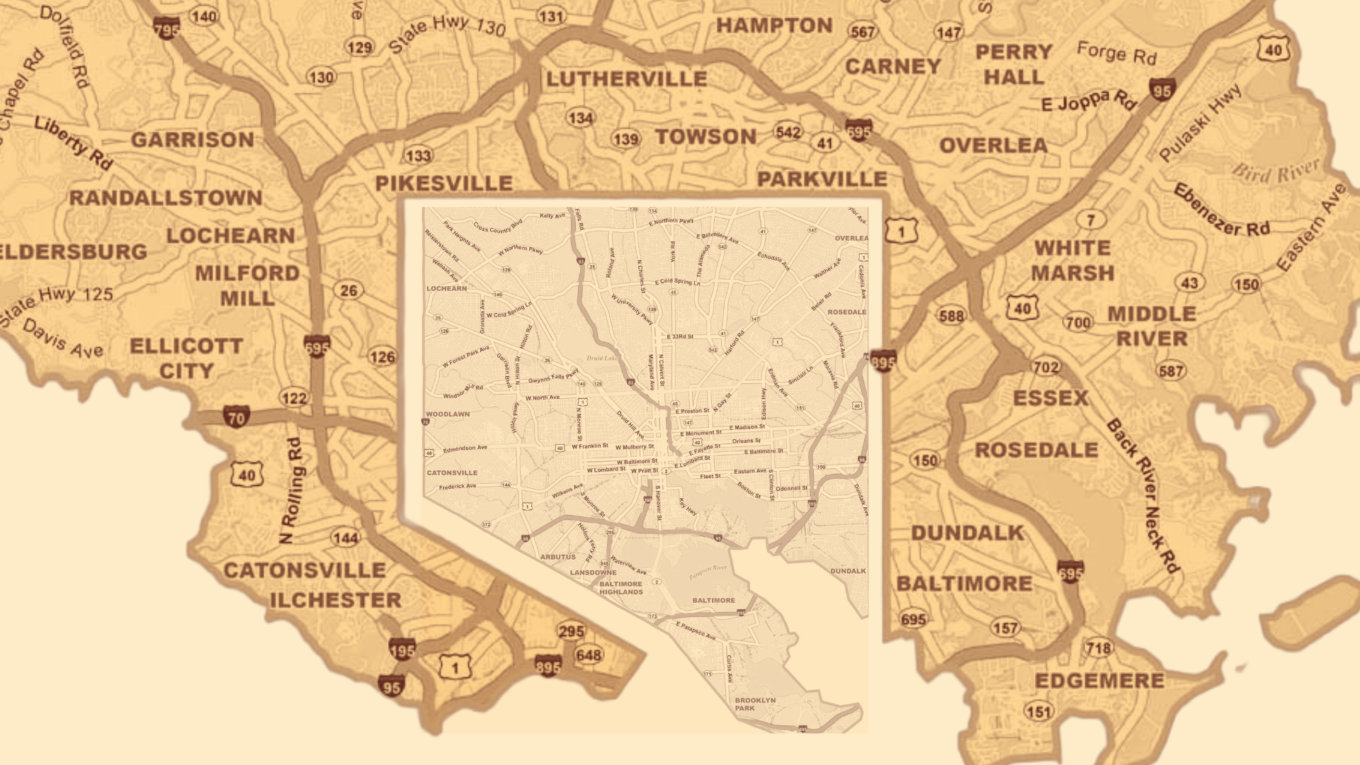
Kate: I hoped to convey something that would go beyond cliché and capture what’s beautiful and real. Certain parts of Baltimore are the underdog and get dismissed as such. Whether it’s Dundalk or Perry Hall or Curtis Bay, the challenge is to parse the things you know on a cellular level about these places and then figure out how to make them hit like a brick to readers who have no frame of reference.
Memoirists struggle with keeping their accounts fair and balanced, and as a reader, we don’t always know what scenes are left out, but I tried to keep my finger on that pulse, hoping she’d get it right. Throughout, I had the deep sense that a lot of care and consideration was given to all the characters, the way Kate developed her own character and the disclosure around certain events, the family dynamics, the detectives, the treatment of Baltimore, and of course, her father. At the end, she delves into the feeling of being hard on her dad. I felt that Kate went a long way in providing everyone with a level of grace while still telling her truth.
Kate: That was the goal. I agonized over treating people fairly. Having a book on a HarperCollins imprint creates a huge power imbalance between me and my family, who surely have their own takes that differ from mine. But they don’t have a megaphone with a HarperCollins logo. As best I could, I wanted to acknowledge and work with that power imbalance. I worked to treat everyone with compassion and maintain an eagle-eyed view—to see all these different people doing their best under difficult circumstances. My friend Gordon Porterfield, who plays a major role in the book, had a maxim I’ll never forget: “You can’t blame people for acting in character.” I think there’s an element of that. Everyone did their best according to their own internal machinations.
If any, what has been the reaction from Baltimore City detectives, current and retired? Upon publication, had you already reached a mental point where their response didn’t matter, or did you craft the story in a way to not tarnish the relationships you worked to develop within the department?
Kate: I was not writing in a way to either preserve or damage relationships with the Baltimore Police. The nature of the work we did together and our interactions were straightforward. There are no secret bonds with Donald Worden or Roger Nolan that I conceal, or details I left out to protect them. What’s in the book is the essence of our working relationship. They treated me respectfully and they helped me when they didn’t have to. They were honorable men who treated me decently, and you don’t always get that with police departments.
The dialogue between Kate and her mother, at the end, evoked deep frustration, but also this sense of knowing, understanding, and realizing it couldn’t be any other way. Her parting words were a raw culmination of years of holding back. Kate eventually breaks the fourth wall and addresses the ending she wanted to give the reader, which is the most genuine, real-world conclusion to a true-crime memoir I’ve come across. The combination of addressing both the limited internal and external arc did give a satisfying literary end. However, I stand by the notion that unsolved cases do deserve publication space, that readers are advanced enough to not need or expect entire resolutions. I asked Kate to talk about the decision to speak candidly about where she ended up mentally and physically with the story.
Kate: I don’t entirely agree with your assessment of readers and their expectations. With 80% of readers, you may be right. And a subset of the true crime readership has explicit expectations of the formula their true crime book should follow. If the book diverges, they get angry.
I wasn’t capable of attempting a tidy ending with this story. It’s not who I am. If I had tied things up with a bow and tried to make it less messy than it was, then someone else would have been writing the book. The idea that Kate solves the mystery and lives happily ever after…that wasn’t reality. If I had gotten that, sure! But I can’t force a triangle to fit into a square. Kate doesn’t solve the mystery and might live happily ever after is far more real.
I’m a flawed human being but I try to be honest. I did my best to tell the story in a way that tracked with my own attempts at integrity.
As I near the finish line for my own memoir about the effects on family and identity after my mother’s murder, I was curious if writing and publishing What Ever Happened to Eddy Crane? created a release valve or salve to the grief for Kate, and if she thought it would last.
Kate: I have no idea how I’m going to feel a year or five years from now. But I know that the thing I’ve always cared the most about since I was a little kid is books. I wrote a good book. The fact that I wrote a book I like is a balm. I worked to the limits of my physical and emotional capacity. Unfortunately, I think I had to injure myself to a degree. If I hadn’t pushed myself as hard as I did, I might’ve wondered: What if I had worked harder, what if I had done more? It’s not healthy, and also, temporarily breaking myself in certain ways is a constant reminder that I did maybe go a bit too far. There is a peace in that. In knowing I did everything I could to write a great book up until and exceeding certain physical and emotional guard rails. If the grief and other painful feelings come back, they will be different. I’ll always be able to say I did this thing, and I feel good about the thing I did. That’s something. Is it enough? In my experience, getting enough is rare.
We discussed the importance of her book in the market, and why we continue to read true-crime memoir. We are in true crime; we didn’t ask to be here but here we are. For me, growing up in the community where my mother was murdered, everyone knew about it, which at times was isolating. In true crime memoir, the stories are more nuanced and go beyond the crime into the uprooting and chaos not shown anywhere else, humanizing the trauma and removing some of the stigma felt.
Kate: That was one of my hopes. Not just for people with a murdered parent but also for anyone who carries something heavy that feels isolating. I hoped someone like that might read the book and come away feeling less alone. I’m starting to get a bit of that feedback, and that’s a comforting feeling. I may have done something that sometimes makes people feel less alone.
Maybe that’s why Baltimore stubbornly lingers in books like Kate’s, and in people like us, grabbing at times a little too tight. You aren’t always gifted clean resolutions and neat endings. You’re asked to carry the contradictions of beauty alongside violence or devotion bound ever-so-tightly to grief.
What Ever Happened to Eddy Crane? is a memoir that resists the mechanism of the true-crime genre. It’s a story that tries to make sense of a city and a lost father who continue to shape a daughter. For those of us still reckoning with our own losses to Baltimore, there is comfort in the rare and steady relief of recognizing yourself in someone else’s attempt to find and tell the truth.
– Shannon Tsonis writes about the effects of unsolved crimes, mental health, and domestic violence. She earned her MFA in nonfiction from Goucher College and is currently writing her debut memoir about her mother’s unsolved murder. Find her on Facebook at shannon.west.372 or at shannontsonis.com/.
– Kate Crane grew up in Baltimore in a tight-knit family of German and Czech immigrants. Her debut book, What Ever Happened to Eddy Crane? A Memoir and a Murder Investigation, explores her father’s 1987 murder and her quest to understand it. Now a New Yorker in California, Crane has written and edited for The Wall Street Journal, Radar, and Time Out New York. Follow her on Facebook at katecrane.