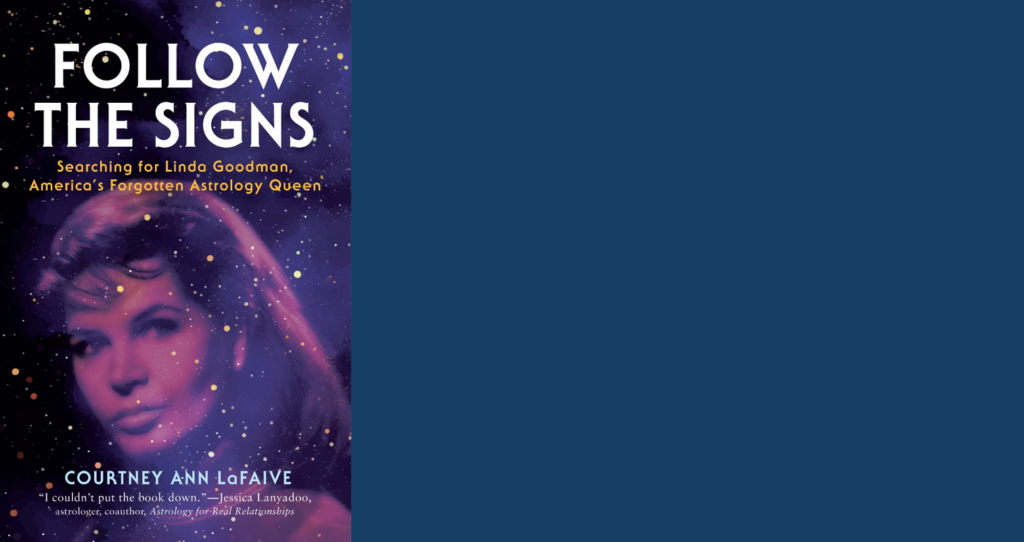
Courtney Ann LaFaive’s second book, Follow the Signs: Searching for Linda Goodman, America’s Forgotten Astrology Queen, came out this spring through the University of Iowa Press. It’s a hybrid memoir-biography that traces LaFaive’s process of researching Goodman’s life while navigating the end of an emotionally abusive marriage, the lingering grief of her mother’s death, and the demands of graduate school thousands of miles from home.
LaFaive’s devotion to Goodman traces back to her adolescence when, at thirteen, she stumbled upon Goodman’s pop-astrology book Sun Signs on the shelf of a local library. It was 2001, decades after the book’s publication. “Why did I pick up…and read a book from 1968 in its entirety in one afternoon?” LaFaive asks herself, and her reader, at the outset of the book. And then she writes to find out.
Goodman (1925–1995) became famous for catapulting astrology out of the esoteric and into the mid-20th century American mainstream, with mass-market bestsellers including Sun Signs (1968), Love Signs (1978), and Star Signs (1987). She was also interested in wellness culture, as well as poetry; in 1989, Goodman published a “telepathically channeled autobiography” in over 1000 pages of rhyming verse. When LaFaive turns to this book for biographical information about its author, she discovers that the text generates far more questions than it resolves. The question that occupies LaFaive is less about determining what really happened in Goodman’s life, and more about how we write a true story about someone whose own versions of truth were slippery.
I sat down to talk with LaFaive on a Monday evening over Zoom. She held a stuffed beluga whale in her lap as we spoke about writing biographies, failure, obsession, devotion, grief, and what it means to go searching for a subject who refuses to be seen.
Annika Berry: What did you imagine it would be like to research Linda Goodman and write this book?
Courtney Ann LaFaive: I was so naïve about what it took to write a biography. I believed that I could know someone and render them in language that could be fact-checked, that I could become an expert. I wanted an intimate archive. I wanted to be able to talk with people about Linda, wanted letters and papers. I quickly found out that she didn’t have the archive that I wanted. Most people [who’d known Linda] were dead by the time I began this research, or had Alzheimer’s. If I’m honest, I panicked. At some point, I showed an early draft to a mentor and was like, “it’s a fail: a fail biography.” I felt like I had failed because I hadn’t been able to make contacts. But I also don’t know if having more of an archive would have made her any clearer to me. Linda’s like a fog—a fog machine!—continuously churned out.
AB: A subject who is a fog machine! Because her life was so hazy?
CL: Fog functions like protection: It’s a substance that obscures you from others and hides who you are. In this way, you might have control over what you choose to push through, to reveal to others. I would imagine there is a kind of comfort in remaining ambiguous. She lied about her life! She said and wrote [in her autobiography] deliberate things that were untrue. She never told anyone her birthday, which I speculate is because then another astrologer could read her natal chart and discover an intimate version of herself. In some ways, she was someone that didn’t want to be known. Even though that was frustrating to me in terms of trying to write her biography, it’s also representative of who she was.
AB: You write about how having little information about Linda gave you more to go off, in a sense. Do you think the gaps in her archive gave you permission to write more creatively?
CL: Totally! I think we [creative writers] have a really exciting opportunity because we don’t have those same limits [that historians or journalists have]. That said, I did what I could. This project invited me to think so much about the sixties, seventies and eighties. The clothing and the era and the music and the food, I was able to pull in those things. I drove to her house, looked at photographs, interviews. Sometimes having the sense of “she could be anyone” felt really overwhelming, but I tried to use what I had as guideposts, and to stay rooted within things that I knew were true, whether that was a YouTube clip or something someone said about her. Even just looking at a picture of a dinner party in the 70s to give myself something to work from.
AB: Alongside your narration of Linda’s life, you’re also narrating your own—but at a remove. There are moments in your writing where it’s clear that the Courtney who’s narrating is different from the Courtney living on the page, conducting the Linda research in real time. How has it been to re-narrate your own experience in the process of writing this?
CL: That’s totally what memoir or nonfiction is, a literal re-narration. I knew that I was driven by this obsession, but when I began, I didn’t precisely know why I was so obsessed with Linda. I was like, “okay, I have this goal. I want to redeem her.” But why? People told me, “you could redeem a lot of things, why redeem this woman?” I didn’t know. Part of the re-narration is a relationship with the reader where I’m saying, I know you see me being naive on the page, but don’t worry. I know I was being dumb and I’m going to tell you why. Another part is healing: me being able to retell the story in a way that helps me understand the decisions I made, to reckon with those decisions. Ultimately, through the process of writing, I realized I wanted to redeem Linda because she’s like me. The kernel of this obsession is a redemption of myself, of people who grieve, of people who are interested in the occult and “things beyond.” I’d been masquerading saying it was about Linda Goodman, but it was actually about these other things. So I think part of the re-narration was articulating my understanding of that obsession and the conclusions I’d come to.
AB: At what point in the writing process did you realize the project was partially about redeeming or recuperating yourself?
CL: I wanted to rid both Linda and myself of shame. I realized that I was, despite my stoic affect, ashamed of my own life choices: to get married so impulsively, to get divorced just as impulsively (though not regrettably), to do a project where everyone flat-out told me it would be very difficult, but forge ahead anyway only to find myself at a diner in West Virginia, having traversed the country in search of Linda, with seemingly nothing to write about her. I grappled with embarrassment, feeling like an absolute moron. It wasn’t until the third draft when I realized I was desperately trying to tell Linda through the page, you can still be loved even though you made bad choices! It was really something I needed to tell myself.
AB: Do you think there is a sense in which all biographical projects are secretly autobiographical?
CL: Yes. I believe there’s always a little speck of obsession or fascination that comes from a personal urge—otherwise it would be hard to do the labor of delving into someone’s life and work if there’s not something that speaks to the biographer that they want to unravel or contend with. There is also a curation of information on the page that may be influenced by a kind of autobiographical proclivity (whether it is about the self or a kind of artistic preference that inherently, in my opinion, is still linked to the self). I think it’s possible to be objective and fair and to try to be as unbiased as possible, but what I love about biography is that it’s a kind of collaboration between writer and subject. Just like a portrait in visual art, it will always be influenced by who is painting, drawing, or sculpting it.
AB: A big element of Linda’s story surrounds the death of her daughter, and her inability to come to terms with the reality of that. You write about how she spent years convinced that her daughter was being held by kidnappers, despite so much evidence that she’d passed away. Would you say that Linda was also engaged in forms of re-narration?
CL: The thing that is so troubling and ultimately tragic for her was that in typical re-narration, you get to have an ending. But she couldn’t make the ending that she wanted, and therefore the story she wanted to tell [about her daughter being alive] couldn’t happen. My hope is that by the end of her life, she did accept her daughter’s death, but that is still a little bit of a mystery to me, how she actually grappled with that. In re-narration and in framing, I do think there’s a possibility for healing.
AB: In writing this book, did you feel like you grew closer to Linda?
CL: I felt closer to her in a lot of ways, I mean I felt a lot of compassion for her. She was so much more multifaceted than I thought her to be. There’s a way that you could look at her life and say, “wow, she never got over her grief.” She had all these, you know, delusions. But in her autobiography she writes very explicitly, “why can’t I accept death?” And through these gestures towards her inner world, I felt closer to her. They also allowed me to see her with more clarity, which made me feel a little bit more distance… and maybe by distance, I mean I wasn’t idealizing her anymore.
AB: Part of writing a biography seems like coming to terms with idealization. But you have to have so much devotion for your subject in order to embark! What do you think the relationship is between devotion and biographical writing?
CL: Leon Edel writes about it as a romantic relationship: The biographer has this love for the subject, and then inevitably through the process of writing the biography, falls out of love. For me, one hundred percent, it felt devotional. To redeem someone is to try to defend their honor, and I really did want to defend Linda’s honor! To be devotional is to put something on a pedestal, to sprinkle angel dust over it. In order to write an honest biography, it’s inevitably a process of having devotion that must be cracked. But I also love the idea of devotion in the research process: Even if you don’t feel devotional about the subject emotionally, you can be deeply devotional to the research. Even if you hate the person that you’re writing about or you’re writing about them because you find them morally reprehensible and you want to suss that out—that’s also devotion!
AB: Tell me a bit more about what it’s been like to live alongside this research for five years.
CL: I got to talk to a ton of astrologers and have really interesting conversations. And Linda sold over 60 million books! It was a really exciting thing that I got to connect with people about. I kept asking, “when you were growing up, did you have a Linda Goodman book? Do you know who Linda Goodman is?” And I loved being able to have conversations with people about that. Even if they were like, “no, like I think she’s bullshit” or whatever, that was still interesting. I will be sad to say goodbye to Linda. I have loved writing this book. I’ve loved thinking about it. On both a personal, professional, and creative level it has felt like a triumph. I feel like creative nonfiction is a kind of alchemy: I have felt transformed by this book, and I’m grateful for what I’ve learned and what I’ve had to embody and accept.
AB: From the beginning of the book, you write about how people around you were always writing Linda off, and you were put into a defensive position of standing up for her. Over the years, you end up coming across things about her life that complicate that simple redemption narrative. Tell us a little bit about your own arc in researching her.
CL: With particular figures like Linda, there’s a lot of stereotypes. I felt like what I encountered was people reflecting the stereotypes back at me about being an astrologer, being a woman, having some sort of invented relationship to madness or mental illness. I was expecting at some point that I was going to run into the origin of those stereotypes. In terms of the research process, I did encounter that, but that wasn’t the big crisis. There were other things that I needed to grapple with: The research revealed something totally unlike what I was anticipating. I had to allow the outcome to be different than what I thought it was going to be.
AB: It’s interesting to think about having an initial expectation for what this research would turn up, then be forced to reckon with the shape of what it actually churned out. Did you ever recognize yourself subconsciously exerting more control over the shape of her narrative?
CL: When writing a biography, you’re dealing with the raw fodder of someone’s life, and our lives don’t always unfold in ways that are satisfying on the level of plot. Sometimes they are deeply unsatisfying. Linda’s life is very unsatisfying on the level of plot. One way in which I could have really treaded into murkier territory would have been if I had manufactured a dramatic arc within her life to make it more interesting. I certainly didn’t want to make up things about her willy-nilly; this trends into some ethically murky territory, which for me would be a biography where the author doesn’t make clear to the reader when they’re imagining something [that is plausible, though unverifiable]. As such, I tried to signal “I’m imagining this!” or “Maybe it was this!” I’m telling the reader I don’t have empirical evidence. And then when I did have empirical evidence, I’d say where I found it. With Linda, because she was such an unreliable narrator of her own life, I also felt like I had to be reliable and transparent about what I was doing as an author to assure the reader that they could trust me as a guide to her life.
AB: Ambiguity is such a central theme in this work, and obsession. In a way, it seems like a book about things we cannot know completely. Or maybe about beginning to recognize a need for something you can’t totally express yet?
CL: We all have obsessions, and sometimes our obsessions don’t immediately reveal themselves, but there is a kernel of something that is interesting, even if you don’t immediately know what the thing is. What is hard [about working in academia] is that you’re demanded to make an immediate argument [for what you’re doing], when sometimes it takes a long time to figure out what that is.
AB: And you pursued this research and writing as your PhD dissertation! How do you think having to justify or prove its merit within academia might have influenced the project?
CL: It gave me a lot of self-doubt. Linda Goodman was a pop astrologer! Astrology on the whole is a bit vilified within the academy, and I had to navigate a lot of internalized judgment and even imposter syndrome about writing about someone like this. The process of this book was not only articulating that to other people, but also to myself. If I hadn’t started working in academia, maybe that wouldn’t have been there. In a way, doing this project within that environment invited me to ask way more rigorous questions than I would have had to otherwise. I also think a lot of the judgment was coming from a little voice within me.
AB: I’m wondering if you could tell us a bit more about your relationship with Linda. Did she feel like a friend? A grandmother? A burden? Or more like a part of yourself?
CL: I think to write a biography is to court a companion who has no choice but to accompany you. It did feel like I was in a kind of relationship with Linda, it’s so intimate. I felt like our stories echoed and resonated. Maybe [writing this was] actually an attempt to feel less alone, to recognize that this person’s story relates to my own experience. I wondered if there was more, and if I just keep excavating this, if there was going to be a little gem for me at the middle about how she, you know, overcame her grief or navigated life and so on and so forth. In the end, I was more interested in the project being a memoir. We all have parasocial relationships, and my hope is that that’s also something that readers can connect with.
AB: Do you think this book gives readers an invitation to have their own parasocial relationships, or follow their own obsessions?
CL: My hope is that it gives people caution about parasocial relationships! That it shows the limitations. I also think my book is a story of youthful shattered illusions. Of course Linda Goodman was not going to be who I thought she was when I was 13 years old [and had first encountered her]. This project represents an old version of myself, a version of myself I had to say goodbye to. A version that was uncynical about love, and innocent about romance and about someone not disappointing me and not failing me, whether that was my ex-husband at the time or Linda Goodman. I look back at the Courtney of this book and think, “I miss her. That’s sweet, it’s so sweet to believe in those things.” Of course there’s so much about that old version of myself that I don’t miss—I’m a much better researcher now! I would never have done this project in the same way! I’m different now, like, you change in the process of writing a book.
– Annika Berry is a writer and visual artist based in Central Coast California. They have exhibited at SITE Santa Fe, MoCA Arlington, and Olympia Gallery in New York, and their writing has appeared in Off Assignment and Tagvverk. They are currently pursuing a PhD in Creative/Critical Literature at the University of California, Santa Cruz.
– Courtney Ann LaFaive is writer, educator, and the author of two books: Follow the Signs: Searching for Linda Goodman, America’s Forgotten Astrology Queen (University of Iowa Press, 2026) and Daughter in Retrograde (University of Wisconsin Press, 2018). Her essays have won prizes from the Bellingham Review, the Southern Indiana Review, and Crazyhorse, and she is currently an Assistant Professor of English at the University of North Dakota.
Cover image “sun rise” by Sean MacEntee is licensed under CC BY 2.0.