
Craft in Conversation
A true interview series in which emerging and established writers discuss the craft of creative nonfiction
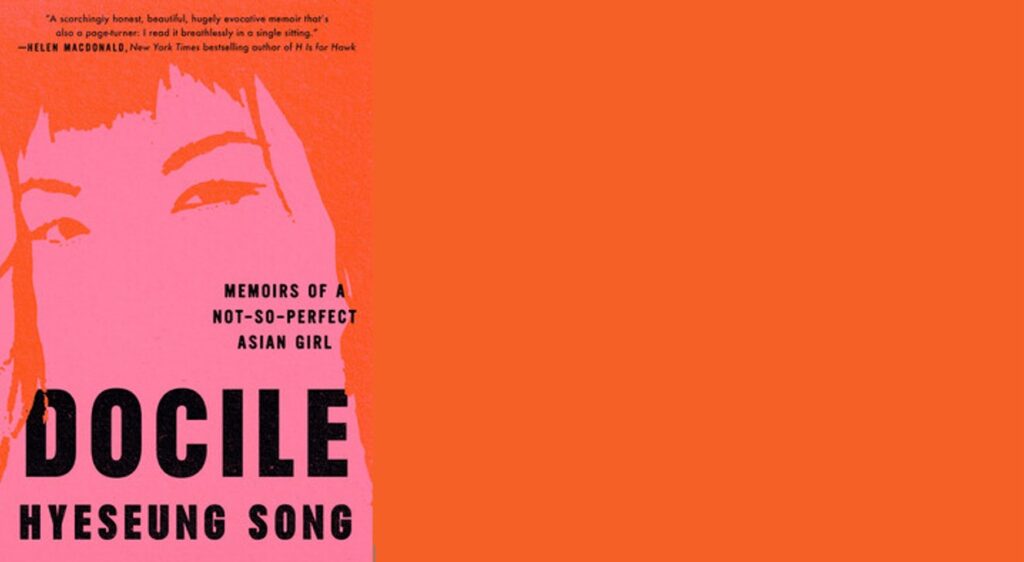
Hyeseung Song demonstrates incredible love through truth-telling in her debut memoir Docile: Memoirs of a Not-So-Perfect Asian Girl (Simon & Schuster, 2024). Docile explores Hyeseung’s search for identity amid the model minority myth and familial pressure to achieve a particular kind of success. In the third installment of true‘s Craft in Conversation series, Hyeseung Song and contributing editor Melanie Hall discuss expression through different mediums, the narrative duality of memory and reflection, and the obligation to write with love when portraying others.
Melanie Hall: Early in Docile, you describe writing in middle and high school with “an extravagant amount of self-trust.” You also say that “writing was akin to smelling. There might be a prompt or none, but always a scent of something.” Do you feel like that is still true for your writing process, especially with a longer work like Docile?
Hyeseung Song: I do, actually. I was at AWP [Association of Writers & Writing Programs Conference] recently where there was a popular panel focused on the idea of writing as “flying by the seat of your pants.” You’re either someone who’s an outliner, or someone for whom writing is “akin to smelling.” You’re smelling, you’re going, and you’re following a scent. For a new essay or project, I use a new notebook with clean pages and just start writing. My generative process is extremely open. My direction is very intuitive. Some people write a lot in their heads before they come to the page. For Docile, what I did was called a reverse outline, where I had a lot of material, an arc that was somewhat visible, and I went back and outlined my material to identify the beats and the tension. So I would say I do approach writing with that scent, but there is also a corralling, a shaping of the container through that reverse outline.
MH: You write, of course, but you are also a visual artist. I’ve seen a lot of your paintings, which are incredible. When you paint and when you write, do you feel there is an overlap in those processes? Is there a certain smell when you paint? Do you think those different mediums accomplish different things for you?
HS: They are totally different things, and I think the differences make both interesting. Some of the questions I pursue are the same, but the ways I approach them differ. In the studio I plan a lot. I am an outliner, a prepper, a planner. I do loads of sketches. I come at my writing practice in a completely different way. Someone asked me, “what is your writing voice?” and I would say that it’s very observant. I hope it’s also intelligent, and I know it must reflect the academic, educational environment in which it was shaped. My painting voice similarly loves detail, and my work has those perspectival, observed brush strokes. I make self-portraits a lot, and of course nowadays I think about how that raises the questions of memoir in the visual art space. Sometimes in writing loved ones, we feel pressure to pump up how kind and good they are, because we love them. But all people are somewhere in between good and bad, and if you really love them, you acknowledge the fact of their complexity and love the whole of them: That’s called unconditional love.
MH: How do you find that balance of writing truthfully about your loved ones while still being sensitive to the fact that they might read it? Or do you try not to think about that and just write as truthfully as you can?
HS: Everybody is afraid of having a memoirist in the family. I don’t think I would love it if someone wrote about me. Even if I knew it was their perspective and they might be writing a particular interaction, they’re not sitting on my shoulder all day, so they can’t see all the dimensions of me. They could only see parts of me. Docile is very communal, like our lives. When I write the communal experiences I have with people, especially the people I love, I have to write first without thinking about their critique. I also have to interrogate very clearly why I am writing about these people, and what my stance is towards them. I wrote about my dad, for example, who died unexpectedly right after the book came out. There are some parts of Docile where I imagine he didn’t love the way he was portrayed. Before he died, I thought I had a clear idea of why I portrayed him that way. But when he passed, I came to different realizations and wish I had been clearer in my portrayal of him. I didn’t have that clarity when he was alive. That’s just how it is. You have to ask yourself if you are writing with enough love, and be prepared that someday your understanding of the material can change. I believe that has something to do with empathy. I thought I had come to the depths of my empathy, but when he died there was a new vast ocean of empathy that unspooled in front of me. Some people would say “you lived through the memoirist’s nightmare, that the person you love is going to die because of what you wrote.” I’m not sure that’s exactly what happened. I don’t think my dad died because of this book he had complicated feelings for, but I do feel a lot of people would immediately shrink away and not want to write the next thing. The answer is not to clam up, the answer is to swim out past where you were, and write again. There’s going to be another time where you swim out past that again and again and keep writing. It’s funny because as writers we can discuss any number of topics about memoir, but always people want to discuss this particular question of how do I write about people and not piss them off?
MH: There is another element of characterization I wanted to discuss. You mentioned feeling like the voice was eloquent, which I agree with. Something that is prevalent to me is the two voices shining through. There is the younger self, the person you were as the events unfolded, and then also the adult writer. The memoirist voice is kind of sitting on the shoulder and offering reflections, but it’s not inserting itself into the scene. I am wondering how you thought about the voice while you were writing to achieve that.
HS: Did you ever read those Choose Your Own Adventure stories when you were young?
MH: A few of them, yes.
HS: When you write a memoir, there’s the author-writer, there’s the narrator, and then there’s the person, the character, living through the events of the book. So, there are really multiple people, and they’re all coming together at various times. There’s one part of the book where you see Hyeseung who is eighteen and then Hyeseung who is writing and reflecting, and that duality is very overt. There’s a part where I recount the things my mother and I say in the hospital. She says “I know who you are, I love you, don’t be worried,” and there is a moment where the narrative voice divides and moves toward the reflective older narrator who wishes she had chosen a different adventure. I could have decided then that it’s not my mom who’s going to complete me. It’s myself that knows me and completes me. That particular point is something I’m very proud of. I have a background in philosophy, so I think a lot about how we avoid certain pathways, and how we are shaped by what we choose and don’t choose. In Docile I put a spotlight on those crossroads.
MH: Something that’s unique to your memoir is the way you recount your parents’ history before they moved to America, some of it before you were born or when you were too young to remember. How did you go about reconstructing those stories? What was the process of obtaining and transcribing a story that is part of your history that you didn’t experience firsthand?
HS: That’s a fantastic question. A lot of memoirs these days use objects as an anchor, as in: I found my mom’s passport, and I asked her or I looked at these photographs which are old and yellowing, and I didn’t want to bring in objects as flashpoints in history. It was important for me to have the book feel extremely propulsive. I wanted it to be read and enjoyed and to flow from page to page. I felt that the narrative was a family history that was told to me many times. There are multiple times where I’m like my mother told me this and my mother told me that. It’s very much passed down through oral history. I do love how other memoirs use those objects and the velocity slows down, because sometimes you want that. But that’s not what I wanted. I wanted a brisk pace. It’s interesting because when your parents are telling you things, the documentation isn’t there. It’s all based on memory. Alternatively, you could say I’m going to look at these old letters and the letter would be dated, but I am playing with my understanding of the truth through oral history.
MH: I’ve heard you say that you spent a long time writing this book, and I’m wondering when that process began. When did you decide that this was a memoir?
HS: I’m a painter, but I’ve been a writer for a long time. It makes sense because my mom loved writing and my dad was a great casual writer. I feel like this came from both my parents. When they sent me to Korea when I was in college, I had a lot of realizations about my identity, and it was a way of parsing my identity of sitting somewhere in between Korean and American, but really being Korean American, a way of being that wasn’t clearly defined in the culture. I started writing the first stories about my parents when I returned from college. The making of Docile is never communicated in the book, but when I came back to Princeton I had started writing the first chapter with some of those childhood memories. I knew I had a memoir when I was in my mid-30s. I kept thinking of myself as a problem to solve. I thought, “okay, I’d be a great student, a great daughter, a great American, a great Korean.” I wrote all these essays in response to solving “the problem of myself.” I printed out this big manuscript and realized that it felt like I was going over potholes. I did a reverse outline because I wanted my story to feel propulsive in the reading. I wanted the reader to be swept along. It took a long time because I was writing on the side of painting and hustling. Docile was a long, long journey.
MH: So you had thought maybe this was just for you, or that you had a handful of essays, and it became a bigger project.
HS: Yeah, it became a bigger project, and I think the pandemic helped make it what it is. I actually went on residency and I met a bunch of writers, because I would only hang out with writers. I would never hang out with painters. I don’t know why. One of the writers was working at a journal, and she encouraged me to send her something because their slush pile was bad that month. So I published “Junkyard Dog,” the story of my dad smelting the aluminum. And someone read it and found me and gave me this fellowship where I met a bunch of famous writers. During that time I queried agents and got the book deal. All of that came very organically, and it was during the pandemic when I couldn’t go to my studio as often. In New York a lot of Asian American women were being targeted from covid Asian hate. I didn’t go outside very much. Instead I wrote the book. That’s the story.
–Hyeseung Song, 송혜승 (she/her), is a first-generation Korean American painter, writer, and teacher. She is the author of Docile: Memoirs of a Not-So-Perfect Asian Girl, about an Asian American woman’s struggle with self-worth and mental illness. Raised in Texas, Song studied philosophy at Princeton University. She pursued dual post-graduate degrees at Harvard, in law and philosophy, before dropping out to study painting in New York. A two-time Elizabeth Greenshields Foundation Grant winner, TedX speaker, and resident artist of The Helene Wurlitzer Foundation of New Mexico, Vermont Studio Center, and the Klots International Program for Artists, Song has taught at the SUNY Fashion Institute of Technology, the Queens Council on the Arts, and the Maryland Institute College of Art. Her paintings have been the subject of solo and group shows, and her work is held in private collections internationally.
–Melanie Hall is a recent Towson University graduate. She served as Editor-in-Chief of Grub Street literary magazine and has been previously published in Discourse, Towson’s academic journal for literary criticism. She is currently working on some personal writing projects and intends to pursue a graduate degree in the next few years.
Cover image “A meadow full of daisies” by A_Peach is licensed under CC BY 2.0.