Craft in Conversation
A true interview series in which emerging and established writers discuss the craft of creative nonfiction
Sarah Minor is breaking boundaries on the essay form. Her debut collection, Bright Archive, combines research, memory, interview, and unconventional visual elements in a wonderful exploration of space and written word. Minor’s writing asks the reader to dispel traditional notions of the essay and to embrace visually and poetically unique works on anything from the imagined space beneath a roof, to oyster shell buttons, to the uncertainty of memory. In true‘s new interview series, Craft in Conversation, Sarah Minor and contributing editor Melanie Hall discuss the art of revision and how the distinct challenges of Minor’s visual style contribute to her writing process. Her forthcoming book, Carousel: An Essay on Seeing, will be available through Yale University Press this July.
Melanie Hall: Is there anything you want to share about your creative process that you think is unique to you?
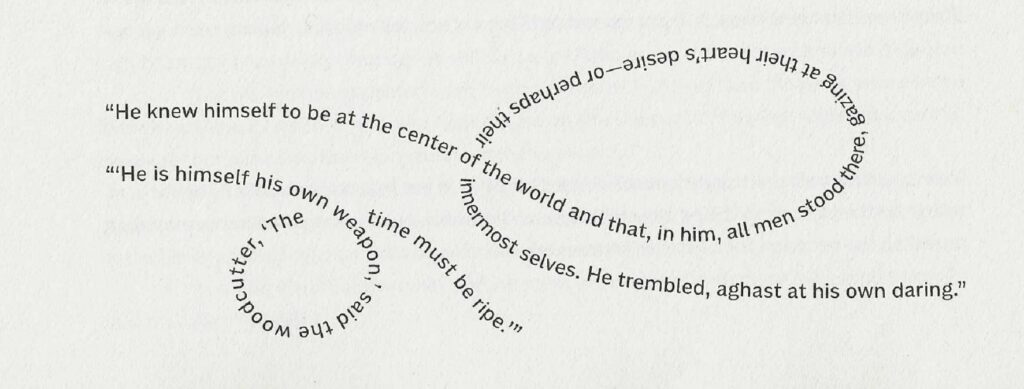
Sarah Minor: Many of the works I’ve published have been traditionally written and created in a design software, like an Adobe program or Photoshop or InDesign. So I’m a writer who is composing for the page, but I am also composing in both space and text. I have to consider those two media intersecting when I’m working on a project, and I think of those creative tools as beneficial to my writing process. They help me keep moving when I’m stuck, but they also create, of course, unique problems that not all writers expect to encounter in their revising and writing processes.
MH: When you play with form and you use those digital programs, do you find that the original writing and the creative design feed off each other in a way?
SM: Yes. What I’ve found most generative about working in those two forms is that I have a certain tolerance for how much time I can spend writing, or how much time I can spend revising. Sometimes I hit a wall. When I’m working in both a visual and written sense, I can pivot when I hit that wall and say, okay, I’m going to stop writing and figure out the design. By working in those margins, by shifting the shape, by trying to get the visuals right, I can keep engaging with that piece, and maybe find a solution to an issue within the text. Sometimes it is a eureka moment I didn’t expect to have, but happened because I was manipulating the space rather than the text.
MH: That’s almost a bit of a life hack for writer’s block, if you can jump between those forms.
SM: Completely, yes. I came to writing after studying in an undergraduate program in visual art, so I was primarily a visual artist for a long time, where my process was very upright. I was in a studio, there were people beside me, and when I came to the MFA, I had to reorganize my way of thinking about and sharing work. So another “life hack” I have as a writer is that whenever I’m having a bad writing day I can just say no, it’s okay, I’m an artist. And then when I’m struggling with a design program I think no, it’s okay, I’m a writer who is just playing in a design program. I was a painter for a long time, so I was working mostly with physical materials. The digital realm still feels new to me. I am doing a lot of self-teaching around it. It involves a lot of searching on YouTube if I need to learn a new way of manipulating a design element. It’s really nice because I’ve gradually accrued more skills with design software. It’s all based on what I want to do, rather than a sense of needing to know every tool, everything a program can do.
MH: Are there any moments that come to mind where you were trying to do the balancing act of writing and programming and designing where you felt it was really difficult, or where it became very naturally intuitive?
SM: One really easy moment, and I’ve only experienced this two times in my writing life, where I imagined the visual form and the content as one, is when I wrote this piece called “The Log Cabin Quilt Square,” which is in Bright Archive. I was sketching a shape and thought oh my god, I know how I’m going to write this. Another time was when I was working on “Lunette,” which is about the history of the guillotine, and in both of those pieces, it came together because I had a really limited shape. It was a shape that had a beginning and an end. The quilt has a very limited form. All the other forms I work in are abstract, or they’re not something that has a natural beginning and end. The relationship between form and text that I’ve found the most difficult appeared later in the same piece “Lunette.” I was learning how to code to make that piece interactive, and I relied a lot on a friend of mine who is both an incredible programmer and a writer to really teach me some new coding language that would allow me to get that piece to do what I wanted it to do. I remember sitting at my computer and looking up how to write the script, or breaking it and not knowing how to fix it, and thinking I’m not going to call my friend. I can figure it out. I did eventually have to call that person again, but it was an experience where I had to learn a totally different way to think about writing. I’m very proud of the result, but I’m not super excited to work in that mode again.
MH: You’ve said before that research is often the first step in your writing process. What does that research look like for you? I am thinking in particular about your essay “A Knot, A Lean” from Bright Archive.
SM: Research is usually the first thing I do when I’m interested in making a new draft. I rely on research as a way to expand my approach to a subject. I often realize that I know a lot less than I want to know. I tend to discover connections between ideas that I hadn’t considered before. Research is a way for me to build the net that I’ll write into a draft. As for “A Knot, A Lean,” I was someone who grew up reading a lot of fairy tales. I was interested in the darker, more original versions of those fairy tales. During my MFA, I held a research assistantship at The Fairytale Review. My job was to read every single one of Grimm’s fairy tales, and map them according to a set of motifs that we were looking for. I would sit on my couch with this huge book of fairy tales, and my spreadsheet, and try to identify where these motifs showed up. So I had just come from this deep dive into this historic set of tales, many of which I was not familiar with, and I wanted to examine a more familiar, popular fairy tale through a critical lens, and that interest drove “A Knot, A Lean” as an essay. It also drove me to write about something very personal that I had not ever thought I was going to write about. I didn’t think I had the tools to approach it, particularly because memory is so twisted, and in flux around experiences of trauma, and so it was interesting how the researched approach to a subject like a fairy tale allowed me to work in a personal mode that I didn’t feel like I had access to before.
MH: Are there any essays where you start with the memory as the idea, and the research comes after?
SM: The first essay in Bright Archive, which is about this eco-cult that I accidentally worked for – that was an instance where the memory came first. I knew I wanted to write an essay about that experience. It was so strange. I didn’t know what was happening when I was there. I feel kind of guilty about that. There’s always emotion around personal writing. I understood that, unlike other essays in the book, this was a personal experience that in itself was really interesting, and it was interesting for people other than me. There’s a wider resonance that’s inherent to it. When I write, I’m wary of writing a story that is only important to me. I am always looking for a way to expand those experiences, or make them relevant to another set of subjects or listeners.
MH: How do you approach writing memory, especially in nonfiction? Some writers can be incredibly concerned with recording every single word, and others tend to go by, if it’s the essence of the truth, and if you’ve made a good-faith attempt at the truth, then that is enough. How do you approach that?
SM: I think about this thing that I heard Catherine Lacey say: “syntax is a motion.” That’s really important in nonfiction, because often, when I work with beginner nonfiction students, the best nonfiction they read they often experience as a piece of text that is the writer’s emotion put directly on the page. They have a direct connection to what they felt – it’s just right there. When actually, when we compose those things as nonfiction writers, there’s so much mediation going on. There’s so much rewriting, there’s so much shaping to figure out how you want a reader to get into it, or understand it, or access it, or misunderstand it.
MH: I am interested in the structure of the “Into the Limen” essay, which has that soffit structure going on. What was your process for deciding that you were going to have the interview with Jim, and also the family history, and then some research about architecture and the structure of the house. It feels very evened out. I am interested in how that particular essay came to be.
SM: That essay has taken so many different forms. I remember early on trying to write it as a concrete text, not having any of the diagram or lines around it, just having those shaped text boxes. I tried to do it as the full blueprint of the house. There was a version where if you opened it in a book, there would be two pages, with different blueprints on either side. The text was so small, and it was almost too much to look at. I navigated so many issues trying to find the right form for this. Why, for instance, does the full blueprint of the house not communicate the relationship between those three sections as clearly as something a little simpler, like the three-part soffit diagram? That’s ultimately what I landed on, this relationship between three things, and I would arrange them so that there was always friction between each of them that was saying slightly more than was said in each individually. Before it was published in Bright Archive, this piece was displayed in an installation. It was printed on a piece of Diazo paper – blueprint paper – so it’s sheer, and the page is blue, so anything printed on it is actually white. You had to place it on a light table to see clearly. It was difficult to read because it was on these giant sheets that people had to stack, and they made this wobbly sound when you held them up, but it really did communicate the materiality of the imagined space of the soffit. I could make a form of the essay where each of those three strands are experienced simultaneously. I’m still considering how to use that braided form, and I see that essay as one of my first attempts at that. I don’t think it’s breaking the boundary yet, but it was something I was trying at the time.
MH: Some of your work has been reformatted many times–you’ve had essays that are revised several times and published or displayed in different ways. Does that process of continuing to change an essay ever stop? Is there ever a “correct” form, or is it fluid?
SM: This is something I’m talking about with my MFA students right now, when they’re thinking about publishing things that they workshopped and revised. For me, something I remember feeling a lot of pain around was publishing a piece that I felt was finished, and then it takes maybe six months or a year to come out in a magazine, and then I would see it and think, that is not done.
It has been satisfying for me to move from an individual essay that was published in, say, a literary magazine, to an essay collection where I have the opportunity to go back and rework or reshape those texts, and at the same time rework or reshape the visual forms that they’re in. There’s an essay in Bright Archive called “Foul Chutes” about following the Mississippi River model with a friend. Before I put it in the book, it had been published online as a long vertical PDF. I had also previously displayed it in a giant installation. I printed this huge piece of horizontal paper and I reformatted the entire essay horizontally rather than vertically, which took weeks. When I was reformatting it, I was running into many moments where the space I had left for a section was different –often a different shape, but sometimes also a different size. I ended up cutting a lot of things while moving that text horizontally. I realized every time I cut something, the piece was better for it. So yes, my pieces often move again and again into different versions, and I think those opportunities force me to revise in a way I might not have decided on my own.
I often have to let go of what I initially thought I was doing and lean into what sounds most exciting.
MH: What kind of advice do you give to your students as they work on revisions?
SM: I think it’s important to just acknowledge that there’s an emotional experience you will have when you first sit down to revise. Give yourself the space to do that. Something that I ask my students to try is to save a different version of their drafts. So you save “my essay, Experimental Version,” or “my essay, Draft” and then I ask them, before they even start to try to revise it, to break it in some way. To add a bunch of space between the paragraphs so that it no longer looks like that neat thing you put together, or to change the font to something really ugly, so you don’t care so much about messing it up, or to start highlighting the different sections in different colors, if you’re working digitally or physically. You have to get the essay to a point where it feels like wet clay again. And if you can’t get there, it’s really hard to begin working. So there’s all this preparatory work that I recommend and that I do myself when we’re talking about revision, that I think solves that emotional issue. You are no longer trying to revise something that looks finished – it looks like it’s in process, and then it feels okay to delete a whole section, to rewrite a line. It is a space to play again. It is a space for process.
MH: You have said that you treat writing like a math equation, which has very much come through in our conversation. How do you feel about that now?
SM: I should say that I am not a math-minded person. I think math is beautiful. I love things like geometry, but that’s not the way I move or think about the world. So when I talk about solving for, or thinking about a specific draft as a math problem, I think what I’m really talking about is drafting, which shares a lot of things with my approach to revision. Let’s say I turn in an essay to a workshop, and the workshop has twenty people, and I get feedback from all of them, and some of the feedback is contradictory. I could take that same essay and revise it in an innumerable amount of ways. I could revise it towards one set of goals, towards another, towards another, and the problem is that I have to go through that feedback and think, which voices are actually speaking to the things that I feel the essay wants to do? I often have to let go of what I initially thought I was doing and lean into what sounds most exciting. And that becomes a way for me to push aside some of the feedback that would lead me in a false direction. It helps me figure out what I’m solving for.
MH: Bright Archive is published with Rescue Press, which is a smaller indie press. Bright Archive is not available on Amazon or through other major booksellers. Did this knowledge affect your writing process at all? Do you have any thoughts about the current state of the publishing industry and how it’s affecting indie presses and authors?
SM: I like the politics of this question, and I like the way it’s thinking about small presses. I have recently changed my answer to this question. There are a number of different political and financial and labor-based decisions that distributors are making, and I believe that Rescue Press is of the opinion that they do want their books available through Amazon, even though it’s an evil entity that steals their money and often gives them no return on the books that they’re selling, because they have such a wide reach, and what the indie presses care about is people reading their books. I think that the question of Amazon is a really important one. It is recommended that folks don’t buy books on Amazon whenever possible, because the amount of money that an indie press makes on selling a book on Amazon is just a percentage of what they could make if you order directly from the press. You’ll get it just as quickly as if you order it directly from the press. It’s just a different mechanism. Of course, there are so many readers out there who aren’t part of that community or getting that message. Some think that it’s also important for books to be available through channels that people understand. I love indie publishing. I think it is publishing. I don’t think that it’s junior or JV to the varsity of corporate publishing. Corporate publishing relies on indie publishing and always has.
– Sarah Minor is a writer and interdisciplinary artist. She’s the author of Carousel: An Essay on Seeing from Yale University Press (2026), Slim Confessions: The Universe as a Spider or Spit (Noemi Press, 2021), Bright Archive (Rescue Press, 2020), and the chapbook The Persistence of The Bonyleg: Annotated (Essay Press, 2016).
– Melanie Hall is an undergraduate English student at Towson University. She is Editor-in-Chief of Grub Street literary magazine and has been previously published in Discourse, Towson’s academic journal for literary criticism. She hopes to pursue an MFA in creative writing after graduation.