A review of Claire McCardell: The Designer Who Set Women Free, a biography by Elizabeth Evitts Dickinson
“The status of womanhood, like the tides of fashion, is always in flux…we live in a head-spinning time that tells women to be anything they want while simultaneously dismantling the progress made for equity and autonomy.” —Elizabeth Evitts Dickinson
Despite growing up in the same hometown as the influential yet little-remembered fashion designer Claire McCardell, I’d heard her name perhaps once before reading Elizabeth Evitts Dickinson’s biography, Claire McCardell: The Designer Who Set Women Free. Named by The New York Times as one of 2025’s most notable nonfiction books, Dickinson’s biography stands out among other books about McCardell for its focus on gender performativity. Whereas other titles have focused tightly on how McCardell’s designs shook up the industry, Dickinson instead brings us along through a highly descriptive narrative of McCardell’s life, starting with her childhood in my hometown of Frederick, Maryland.
McCardell lived and died long before I drove the streets of Frederick, but still, I am transfixed by her. A young McCardell earned the well-deserved moniker “Kick” because she was known to deliver quick strikes to the shins of neighborhood boys; she was the only girl among the group. McCardell’s life and work were characterized by this forceful resistance to gender boxes and all of their baggage. In this kicking, I can’t help but see myself.
Though Dickinson primarily follows McCardell’s journey in the fashion industry—from small-town Frederick, to fashion meccas New York and Paris, and back again—she thoroughly fills in the surrounding details, showing us the supportive community of women from which McCardell’s passion for freedom through clothing emerged. The settings are rich and tangible; each person McCardell interacts with feels just as complete as her. We learn from Dickinson that McCardell lived for a time at the Three Arts Club in New York City, a modest boardinghouse managed by women for women. Though the rooms were small, cold, and not always safe, Dickinson captures the compassion of the place through language. She tells us that McCardell was struck by the beauty and warmth of “gilt-framed oil paintings lin[ing] the walls,” “sprays of fresh flowers adorn[ing] end tables,” the “smells of baking bread and furniture polish,” and the sound of “young women chat[ting] over pots of tea in the parlor, while somewhere in the building a violinist tried mightily to find her proper tune.”
By the book’s end, Dickinson has given McCardell a depth and interiority I often associate with the characters of novels. From being punished for swimming without stockings as a teen, to her limited housing options, we see McCardell navigate the unforgiving gender expectations that restrict access to education, limit career possibilities, and instruct romance and courtship across her entire life. Nevertheless, her drive to question, push against, and break away from social boxes never lessens in fervor. Other designers of her time—notably, Christian Dior—wanted to “save women from nature” and reinforce traditional ideas of femininity. McCardell, as Dickinson tells us in the book’s title, wanted instead to set women free.

McCardell’s Frederick and New York City were mired in old mindsets. Frederick was steeped in rigid gender roles—where women could go and when, what women could wear and when, what women couldn’t do. The women around her urged her to follow the same path to restrictive housewifeship. Education options were limited. We learn from Dickinson that McCardell was “learning to walk the line between having her way and staying in the good graces of her parents and her community,” depending on her family for financial support while disagreeing with their ideas of who and what she could be. Skittish New York had seen women enter the workforce during the Great War, only to be forced out when the men returned and demanded a return to how things were before. All around McCardell, boxes pushed in.
The shrinking of these boxes prompted McCardell to kick harder. She reimagined gendered associations in her designs, using all types of materials regardless of who was supposed to wear it and when. Her deft hands brought to life evening wear spun of wool, traditionally reserved for daytime suits and outerwear; women’s suit pants and jackets made of tweed, cordoned off for menswear. She worked with shapes that avoided contemporary gender fashion tropes, creating women’s clothes that critics described as manly and unladylike. They called her designs crazy, but she simply adopted the comment, calling her works “her crazies.” Her setting led with rigid, black-and-white thinking. A successful American designer meant the death of revered Paris fashion. Women having functional clothing meant the death of the gender binary. Neither of these were acceptable.
Both of these forms of power—capitalist dominance and gender essentialism—are dependent on bifurcation, a strongly maintained binary. One cannot be above without another below. McCardell faced fierce pushback for her gender-shaking style. If women could dress like men, would they stop there? There is always a threat.
One hundred years after McCardell’s restricted upbringing, what has changed?
*****
An unnamed discomfort hung over me throughout my youth. I found it in my shoulders, my chest, my voice. As I aged, it became more specific. I was too angular, too rough. I took up too much space. I acted first and thought next, and I was taught that this is right—that boys will be boys.
Before I was out to my family, my life was bifurcated. Moving to Baltimore for college gave me the perfect opportunity to explore myself—home I was him, and away I was her. I achieved this mainly through clothing, making sure that no one who knew me as one gender ever saw me as another. If I could control who knew what about me, I was safe in the separation. This was a full-time job. Often, I’d use so much energy masking at home that my only place to breathe was in the car, on the roads of my hometown. I’d drive down Rosemont Avenue toward West 2nd Street, past Culler Lake in Baker Park, and around again. Hugging the lake and the park is a neighborhood filled with old trees—Rockwell Terrace. The houses are clearly old—19th or early 20th century, I always reckoned. I’d slow the car and dream.
In each house I imagined a future me, happy and old and myself, surrounded by the trees and peace of Culler Lake. One house in particular, a classic Dutch Colonial at 301 Rockwell Terrace, has always been my favorite. I want a wraparound porch when I’m old, I would think each time I passed it. I have to get there first, I would then remind myself. And right now, that feels more uncertain than ever. I didn’t know then that my favorite house had once been Kick’s. She had grown up just down the road from where I was kicking, too.
In 2021, a statue of Claire McCardell was unveiled along Carroll Creek, larger than life, looming at twice my height. And somehow, I never saw it.
*****
In McCardell’s Frederick and my own, her New York and my Baltimore, it is hard to escape men clinging desperately to old things that have already passed—old definitions, ways of seeing others around you. It seems these men have found their way to D.C. too. Now more than ever we must interrogate how we define womanhood and gender, and to remember those who have done it before. Despite cultural attempts to have names like McCardell forgotten, her story is ever present in daily life as an American, a woman, a person. Elizabeth Evitts Dickinson is one of the many authors leading us in the dire, urgent work of remembering and recording. Thanks to women like her, McCardell’s desire to free women from the strict box of gender conformity still burns bright.
McCardell and Dickinson alike remind us of the agency and choice that go into how we define social boxes like gender. Dickinson speaks to how this showed in McCardell’s work, saying, “The more a woman could stash on her person, the more freedom she had to act.” Agency and action were key parts of McCardell’s designs, influencing the incorporation and size of pockets, the placement and styles of zippers and fasteners. “McCardell didn’t care about precedent,” Dickinson continues, she cared about the lived experience of women. Dickinson’s punchy and direct language mimics McCardell’s head-on drive for freedom in fashion. Like McCardell’s innovative use of materials, Dickinson’s words are each imbued with purpose and intention—the performance of language an analogue for the performance of gendered fashion. Looking out into the world today, it feels more and more common to encounter those who argue that the social performance of gender is actually biological. We need this reminder. There is no better time for this book than now.
*****
In Baltimore, where no one knew me, I could start again. I could write my own definition for myself. Test my own limits. A new name, a blank slate self. I had little control over my body, but I could control my clothes. Thank you, Claire McCardell.

I started at the legs. Exploring different tops was overwhelming, but pants I felt I could handle. I had lived thus far within a tight box of jeans and cargos, feeling the necessity to match dress with the boys around me. Now I was drawn to maxi skirts (chiffon and cotton twill and midweight linen) and palazzo pants (georgette and crepe and rayon challis)—anything but restrictive, straight-cut denim.
Eventually, my exploration into gender expression spread both up and down. New shirts, shoes, accessories. There was—and still is—an exhilaration in trying a new style, a new way of presenting. Every switch, each individual piece, showed a different me. Early in college I made and lost friends quickly. Tied up and focused on reinvention, I had dissociated from myself and into my clothes. I felt if I pantomimed the person I wanted to be then I’d become her somehow, some way. Like McCardell began to understand in her youth, gender is an act of mimicry. McCardell’s life is not an extension of her designs, but rather an embodiment of her life. As Dickinson reminds us, “Designing ‘is just my way of expression,’ [McCardell] once explained, ‘as speaking is not.’”
Now, I blend store sections in my drawers—men’s jackets and women’s skirts and men’s shorts and women’s shirts—and know that I am a woman. But that doesn’t stop the glances and glares when I’m noticed in a space deemed theirs.
Five years into my transition, I feel I’ve broken away from that old box—boys will be boys—finding for myself new words and names and ways. I have found community, and keep finding more. Many of the closest people in my life are trans, and around them I don’t have to think twice. This community is especially valuable today, when trans safety is a question and security feels like an impossibility. I still battle with my clothes. That is one thread that I cannot yet untangle. My head knows what my chest resists out of habit. Clothing and gender are not entwined. Fashion is fluid, constructed. Likewise, gender is an outfit we don.
*****
Dickinson opens McCardell’s biography with a scene recounting a conversation between McCardell and feminist writer Betty Friedan about the gendered challenges of being a driven, career-focused woman in the 1950s. Their challenges remind me of myself, of the fears that have persisted throughout my transition. Whenever I catch a stranger staring or find myself the only trans person in a space, the urge to conceal myself bubbles up. Sometimes, safety through secrecy sounds more plausible than comfort through sincerity—particularly in today’s political climate. Yet, I can look to women like McCardell, Friedan, and Dickinson for hope. Their lives and their creations—whether fabric or alphabetic—remind us of the power of an agentive woman. Dickinson’s dip back into the historic record shows us what McCardell said to Friedan in the face of constant attacks on women’s personhood and potential. McCardell urged us forward, saying, “You can’t go back.”
—Juniper Scott (she/her) is a young Baltimorean writer capturing her experience as a trans woman in today’s America. Her Substack features writing in the primary genres of personal essay and memoir, which change form and face from piece to piece—a shifting style for a shifting self. Through her nonlinear and associative style she explores gender dynamics, control and fear, responsibility and authenticity, wrapped up in the jagged blanket of contemporary American politics. Currently, she is studying at Towson University. [IG @juniperscottmusic]
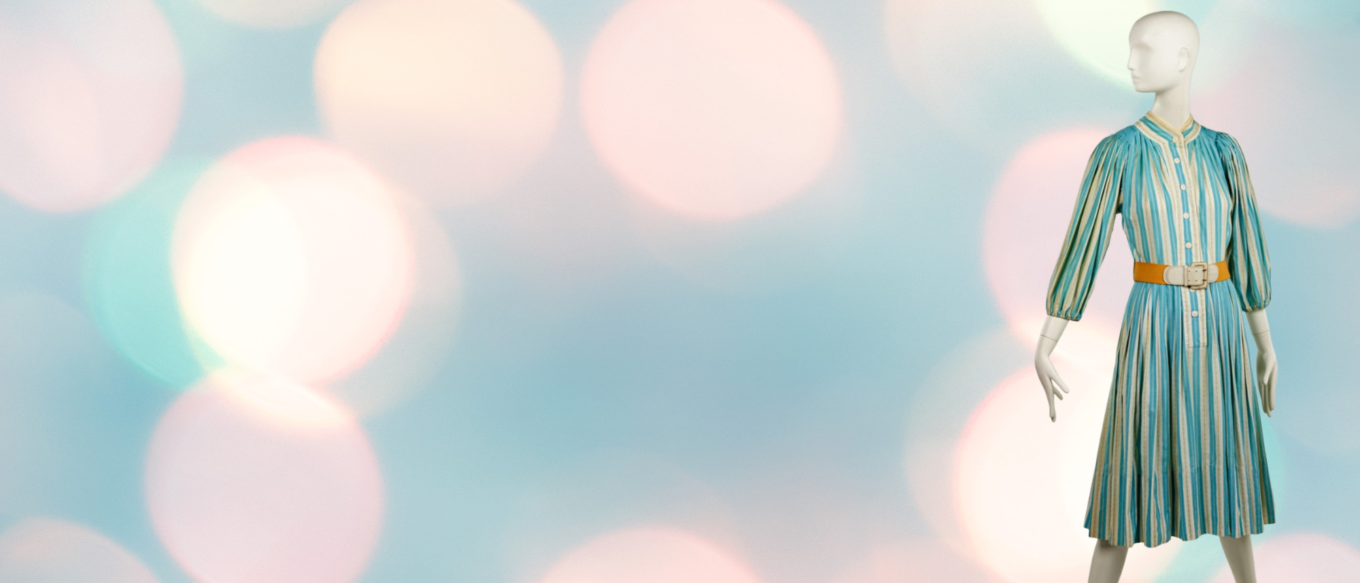
Cover image: “Claire McCardell day dress, blue and white striped cotton, early 1950s 02” by Photographer for the Rhode Island School of Design Museum of Art is marked with CC0 1.0.