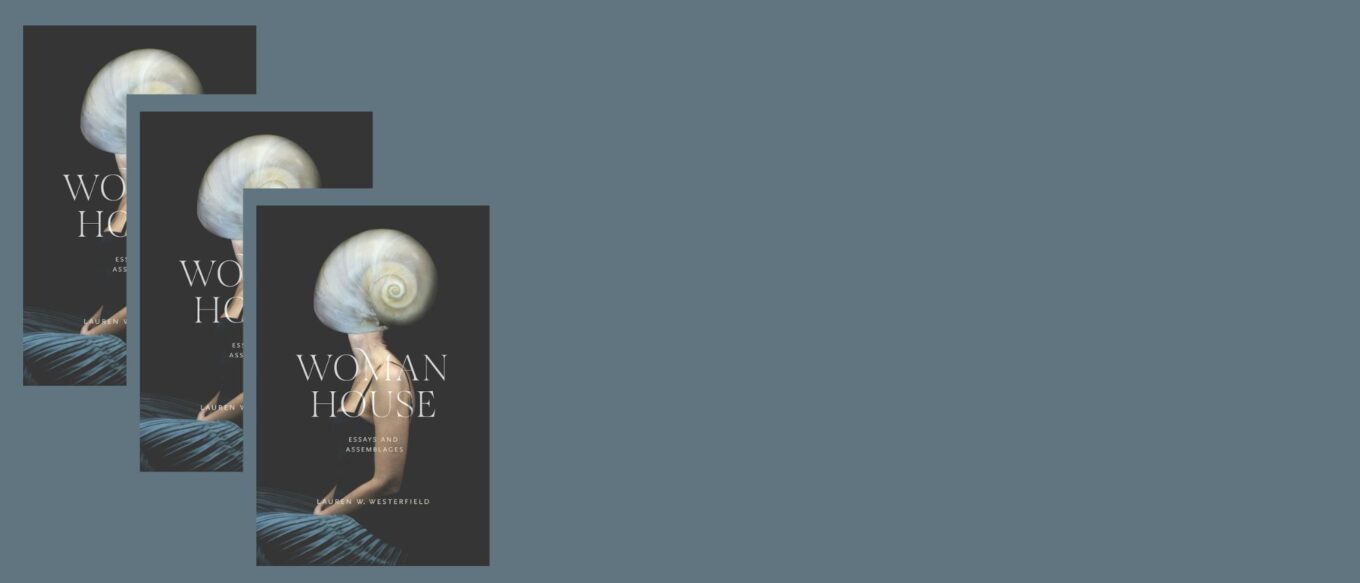
Lauren Westerfield is no stranger to the complexities of writing “the true story.” In her latest book, Woman House: Essays and Assemblages, Westerfield keeps the “creative” in creative nonfiction alive while maintaining intimate and honest portrayals of self and family. But memories are slippery and vague. How do we write nonfiction when we don’t know whether our memories are accurate? That question lives in the heart of Westerfield’s craft. Woman House is a fractured text in which Westerfield explores her relationship with her mother, iterative memories, tellings and retellings, and the folded layers within a sense (or senses) of self. The result is a beautiful memoir built from intimate moments, fragmented memories, and collaborative questioning of the past.
Lauren Westerfield sat down with Brandon Arvesen for an annotated interview about how to tell the truth in the face of uncertainty and how to be vulnerable on every page. Woman House: Essays and Assemblages is available March 3rd from the University of Massachusetts Press.
Brandon Arvesen: You’re thinking about an essay collection, and you have all this research into Louise Bourgeois and Joanne Kyger, but how does this come together for you? What’s the approach and how’d you wind up here?
Lauren Westerfield: I started putting it together during the COVID lockdown when I had all sorts of time. I was teaching remotely, and that opened up a lot of free time in my day that I wasn’t used to having. Graduate school and the MFA were several years behind me at that point. I’d written my first book, was shopping that around. And I was sort of going through all my drafts, fragments, and things like that. And I had these first versions of essays that engaged a lot with my family and specifically my relationship with my mother. I had sort of set a lot of that aside early in my graduate studies because I had shifted focus with what I was working on and studying and where my thesis was going. But I had all this work I’d been thinking about, and some of it involved research that I had done before graduate school, during graduate school. There’s an essay in the book, “On Becoming”, that has been through many an iteration. A lot of the research into epigenetics happened during an environmental criticism course in grad school in my first semester. And I thought, “Oh, I can bring these things into conversation.” Inherited trauma is in the body and in our stories and narratives and families, and it is also an environmental consideration. How can I weave my interests in personal narrative, memoir, and family stories into my research paper for this class? As an MFA student taking a lit course, I was able to finagle my way into a creative assignment.
BA: A graduate paper is an interesting place to start a memoir.
LW: I wrote a version of an essay with a lot more research in it. I put things in, took things out, put things in, took things out over many, many drafts. But things that I had worked hard on and then set aside came back to the forefront when I was stuck in my apartment with my stuff and nothing else to do. I started to piece together some of the narrative. There were some patterns repeating and some things that I was clearly engaged with but hadn’t really delved all the way into. And then I’d written the essay that is the opening of the book, in some ways a little bit of a prologue to the project. I wrote very much in real time while it was happening. I describe sitting in hotel bars, researching and writing, and that is what I was doing, and that became much of the essay. It was picked up for publication and I was like, “Cool, I did a new thing as a non-grad student. I can still write and publish work.” And then I got distracted with life and teaching and working. When COVID came around, I wondered what shape these ideas might take if it were to become a book project. What are the gaps and what are the other stories I want to interrogate, and what are some things I need to explore? And that launched me into exploring more facets of my relationship with my mother, of her relationships before and during and after my childhood, and what that wrought for me in terms of my own coming of age and understanding of my own story.
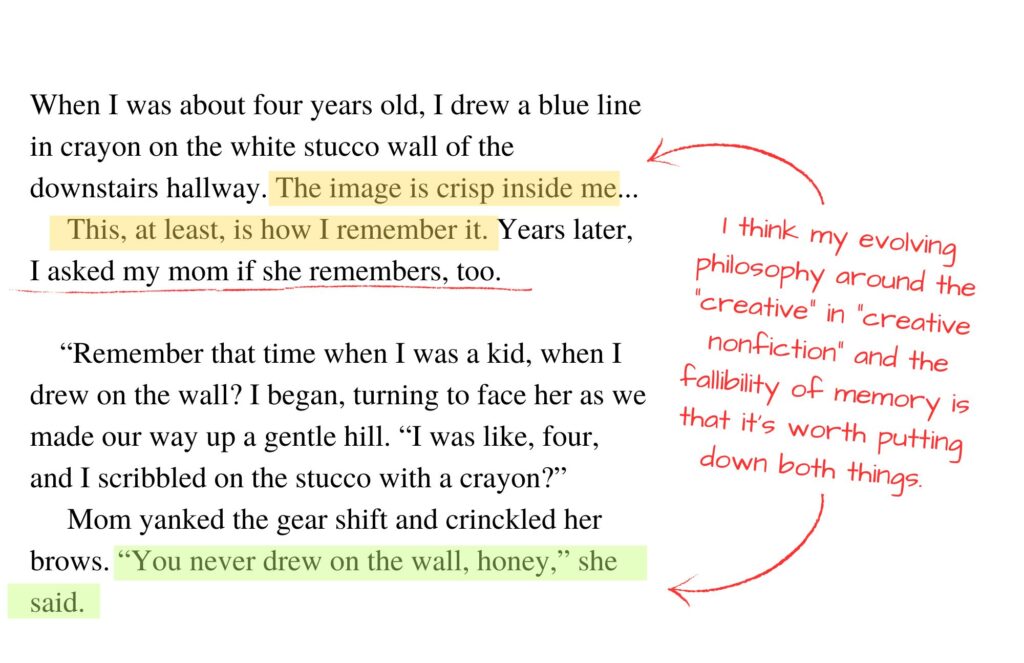
BA: You write in the essay “On Becoming”, “I could even learn, as I will later, just how much of this is fiction. How family history… gets warped in the retelling.” And that seems like a consistent throughline much later when you’re asking your mom about concrete and formative childhood memories and she replies, “That just didn’t happen.” And you’re like, “What do I do with that?”
LW: Yes!
BA: So, what do you do with that as a nonfiction writer? What is your approach to the unknown? How do you bring your reader into the resonant truth that you’re trying to give them?
LW: Some of my early thinking about nonfiction came from the Tin House summer workshop. It was my first immersion into nonfiction-specific craft conversations and debates about nonfiction, autofiction, and where these lines can and should be drawn. I learned about John D’Agata’s philosophy about nonfiction. He has a fast and loose interpretation of what truth and nonfiction can be relative to style, sound, and the shape of the project that he has in mind. And then there are people who have a very strict journalistic, fact-based interpretation of what is truth and nonfiction. And then there’s so much in between. Then there’s autofiction, where the writing is nonfiction except for the things that aren’t. All of this was totally new to me at the time. I wrote a version of what became “Still Life” in the book.
Originally, I wrote it from my mother’s internal monologue. I italicized the narration to suggest it was imaginative reconstruction. It wasn’t a great essay; I didn’t really know what I was doing. I’ve had a tendency for much of my writing life to overshoot on structure and formal experimentation before I quite know what the meat of the piece is because I get excited about something experimental that I want to try. At the time, I was reading my first autofiction. I was reading Sheila Heti’s How Should a Person Be? and Maggie Nelson’s Bluets. I was starting to explore all these different forms that nonfiction can take. It took me a while to get around to Joan Didion’s On Keeping a Notebook and the idea that my memory of how it was is important to my understanding of who I was and what I’m trying to capture, perhaps sometimes more so than the facts of the moment. Didion has an anecdote in “On Keeping a Notebook” where she remembers having cracked crab at lunch, even though she couldn’t possibly have had it when she looks back. That memory is so strongly associated with the time for her that she shares both.
BA: Your writing deals with the fallibility of memory a lot.
LW: I think acknowledging clearly that there is an element of inevitable misremembering or varieties of perspectives and viewpoints to me feels like a fair contextualization. I’m a person with memories and they’re my memories and my memories are going to have all kinds of cloudy, patchy, subjectivities built in. And so will my mother’s and so will my friends’ and my exes’ and my partner’s and all these other people who are involved. Not to mention everyone else in the family who tells these stories that get passed down. There are going to be intentional and unintentional, conscious and subconscious, adjustments to stories over time. So, I think as long as it’s acknowledged on the page that it is happening and that it’s not a journalistically accurate piece of reportage, I’m comfortable hanging out in that gray area.
BA: When you don’t know, your mom doesn’t know, or nobody knows, you could find yourself so beholden to a fact that you evaporate it from the piece.
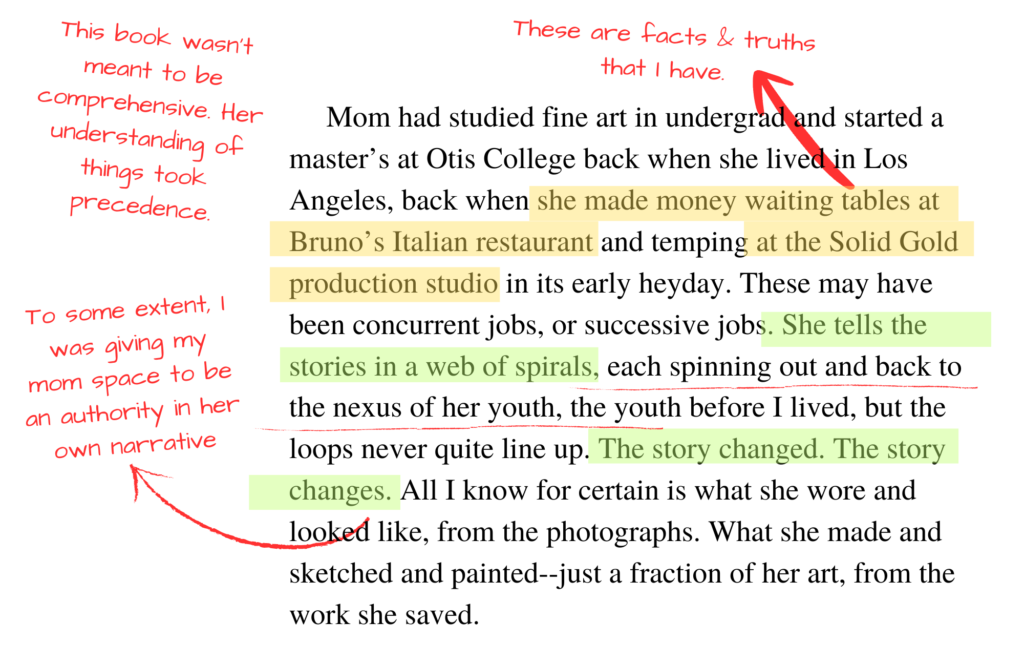
You write, “It is impossible to fact check my emotions.” Your writing brings the reader into so many different intimate moments at so many different times. It’s a fragmented ride but somehow comes together. So, if you’re not fact-checking your emotions, what are you doing with your emotions to keep them both relevant and non-destructive in your writing?
LW: I love that question. I was in therapy, so that helped! Having another place to put the emotions besides the writing so the book isn’t therapy. It’s inevitable that processing is going to come to the surface with writing about family. Some writers stand close by that adage of “Don’t write in the immediacy of the feeling.” I think sometimes one does not have a choice, or perhaps it is valuable to capture some of that immediacy. For me, the management part often comes in the editing. I’ve had the very good fortune of working as a book editor for Split/Lip Press. I was their essays and hybrid editor for about four years. I worked with maybe eight different authors on chapbook-length and full-length nonfiction. There were often hybrid and experimental, often fragmented, often memoiristic, often very intimate and personal books. And so having had practice assessing that as a sympathetic and enthusiastic reader who helps select these manuscripts, but also not the author, I think I had the opportunity to think through when and how something feels emotionally understood with enough depth and self-awareness that the author knows what they’re putting out on the page. Some of it is practice, some of it is good editors, learning to be a good editor for yourself, finding your best readers, and processing through those emotions again away from the page.
BA: What’s your process for managing all that?
LW: Well, I want the rawness to be there when it needs to be there on the page but not spilling over beyond what I want to have show up on the page. I always go to the metaphor of adjusting volume knobs. How do I turn this up or turn this down? Maybe I can fuzz this out a little bit, but keep the illusion. Maybe keep this echo here, but not hit people over the head with it. Noticing patterns is really important too. I want this pattern to be threaded through the book very clearly, maybe this one’s a little bit more of a sub pattern or a sub theme. And then this one I didn’t realize was in the book until I started organizing the manuscript. Maybe I don’t want that to be quite so overt here, but I do want it overt there. And where’s the moment across the manuscript where this intimacy or this reckoning or confession or admission of something is going to be the most resonant? I have no problem with confessional nonfiction, but I do think it’s worth paying attention to and being aware of when and how it’s used.
BA: Is there a moment where the volume was too loud and you came in to adjust? I ask because there are levels of intimacy where you put yourself out there in your writing.
LW: One of the things that informed the edits in this book was my first book, Depth Control. That book also involved a fair amount of intimacy, disclosure, and vulnerability. It was very oriented around romantic relationships and coming of age. The focus was more on the self, the body, gender identity, and relationships, and less on family and inherited understandings of where that’s coming from. And so the body and physical intimacy and sex and romance and just bodily messiness was a big part of the theme of the book. So, when it came to Woman House, honestly, I felt like the intimate stuff was small potatoes by comparison. If I’m examining my understanding and relationship to some very personal experiences and just conceptions of self, body, safety, value, intimacy, worth in the context of my mother’s experience, primary amongst which was sexual assault and its aftermath, then these are important details. This is part of what I am exploring here. While I don’t have a particular moment for you, I do remember editing some pieces, essays that involved romantic relationships or allusions to past relationships, and trying my best to take out anything that felt gratuitous. I put it there in the draft because it felt like it was the texture of the experience or the scene or the moment, but it doesn’t need to be in the final draft.
BA: That’s interesting. The emotional truth becomes clearer through the withholding.
LW: One important piece to this that I haven’t talked about yet is the sobriety narrative. It comes up at the end of the book but is threaded throughout. The relationship between intimacy and alcohol in my mother’s life and in my life is essential to the book. It’s also something that I didn’t know was going to be essential to the book when I first started writing it.
BA: How did that narrative manifest during the writing?
LW: Well, I was drinking at the time! That’s in some of the essays. But my desire as an editor and as an author to complete the manuscript, have it come together at the end, really forced my hand. I thought, “I think I’m going to have to quit drinking for this to work because this story is just going to be too sad if it ends with: “And then they sat there drinking their wine and looking out the window together. The end.” And because drinking was so tied into the more intimate relationship experiences, again, both my own and my mother’s, alcohol became a thread that I was actively looking at really closely in revision.
BA: That’s so interesting. Looking back, there are so many scenes where alcohol has a gravitational pull.
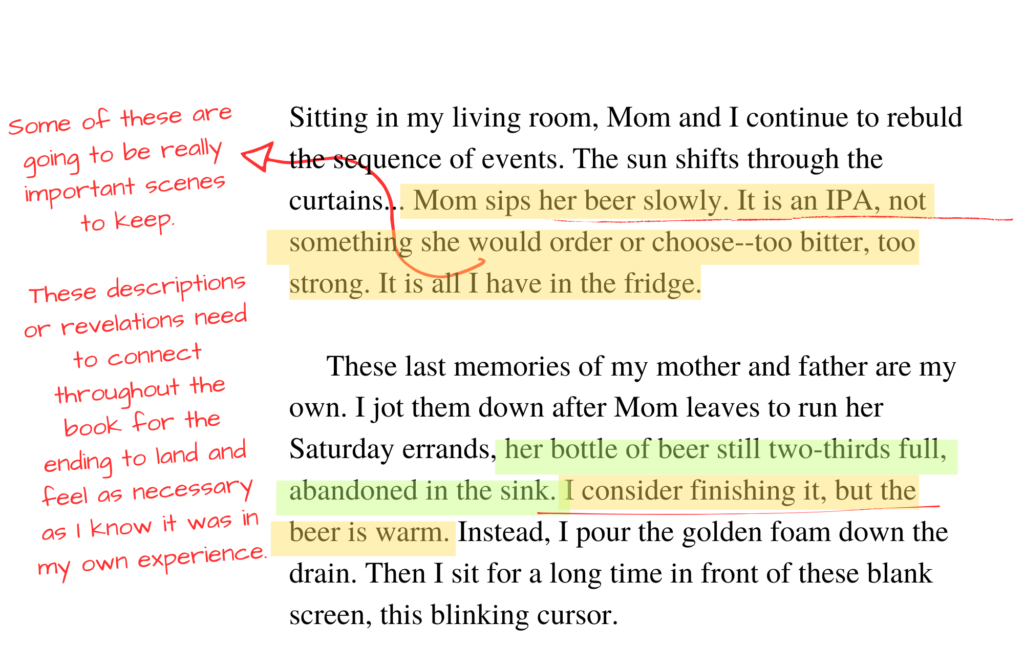
You’ve clearly done the introspective homework for yourself, but you can’t do the introspective homework for your family. As someone who’s putting her own intimacies on the page, and therefore also bringing us into this world of your family, was exposing other people’s vulnerabilities (in sex, in drinking, etc.) a concern for you at all?
LW: With my mom, I would ask, “Is it okay if I put this in? Is it okay if I write about this?” I checked for a variety of reasons, most of which are her own mental health. When it comes to her emotional disclosures, there was conversation, consent, agreement, and discussion before anything went onto the page or went into a publication. My intention with the book in part was to give my mother a space to feel seen and understood. Because of that, I did want to give her voice and memory a primacy on the page. This book was sort of her take on things. I told my father that when I was working on the book and made sure he understood and was okay with that.
BA: And with intimate relationships?
LW: I have had conversations in the past with some people involved. Those conversations were before this book, but I had conversations in the years following relationships about writing about the relationship. I don’t feel like that is some kind of blank check to say whatever I want, but I do think it’s important to resolve some of the important threads from that relationship in relation to these other issues explored in the book.
BA: It invites us into that vulnerability you were alluding to earlier. The book wouldn’t work if you just reported formative events that happened to your mom. If all you wrote was how she experiences her own body and her own life and her own sense of self and didn’t include how you experience your body, your life, and your sense of self, you’d lose something. That’s where your memoir feels alive to me. It doesn’t matter what form the next essay takes because I’m learning so much about you and her that the story just… happens.
LW: Oh, I appreciate that.
BA: From the very first sentence I was like, “Oh, we’re in for a ride.” You bring your reader this intimate yet fragmented experience; what do you hope they walk away with after reading?
LW: My gut response to that question is some sense of recognition. That doesn’t necessarily mean that the reader is a woman or a daughter, but that’s probably a first line of immediacy with recognition. I’ve had some conversations with women and female identifying people I know who feel seen. I’m honored that they feel seen and connected to aspects of the mother-daughter relationship, the caregiving relationship, the sobriety journey, the self-understanding journey and these tensions around freedom, control, expression, and intimacy as a woman and a female body. That’s really important to me. I think some of the most resounding validation or feedback I’ve received is when someone is like, “I needed to read this.” I’m in a position with a bit more access to publishing, and I can put something out and share it. I hope it feels necessary and permission-granting or just validating of experience, that’s so important to me and it’s so worthwhile.
BA: Your book defies a common memoir writing adage about waiting for family to pass away before writing. What advice might you give about this collaborative approach to writing about family, fact-checking feelings and emotions, and interrogating stories together? Do you have any advice or any tools to engage in writing about family with family?
LW: It’s going to be impossible to give universal advice. I would say first and foremost, think through your motivation to write. Many writers have said this more eloquently than I’m going to say it right now, but check yourself. Is this revenge writing? Is it processing writing? Are you just pissed off? I’m a writing teacher and I see early drafts of first- or second-semester creative writing students experimenting with their writing. Sometimes they need the vent session about a parent or stepparent or partner or sibling. I think you have to get that out. If you need to do that first, do that! I think there’s much to be said for putting something “in a drawer.” I didn’t plan to do that with this book, but some of the drafts that became pieces in this book were sitting in a drawer for a number of years before I came to them again. And some of those early versions about my relationship with my mother were “venty” and whiny. “Woe is me. This is so hard for me. She’s so terrible.” It’s like that angsty voice needs its opportunity to get out, and you can shape that later. I think it’s great to have that on the page because you can go through and read it and be like, “Oh my goodness gracious… but this line is true to how I felt, and maybe I can use this.”
BA: How might a writer use that one line?
LW: I think you use it with the acknowledgement that you wrote a version of this essay years ago! You say, “I wrote this, and as much as I cringe to read the rest of it, this line still rings true and here’s why.” I think it’s okay to work with that disclosure and sort of fourth-wall breakage. I admit when it is hard to put something on the page and I’m trying to have distance and I’m trying to have some increased awareness around what it is I’m saying, but it’s really hard to look away from this feeling that’s super strong for me still and has been for a long time. And then approach family and say, “I’m grappling with this and I’d love to hear your story.” I don’t think many people genuinely dislike the idea of being asked to tell their version of things, especially when there’s something that maybe they felt they haven’t had the chance to share.
BA: And if they say no?
LW: There is the writing into the unknowing. Being forthright about what you’re working with, if family members or just people in your life say no, working around what you can write about can be a creative constraint. It’s like a sonnet. What can you do with the space you’ve got?
BA: The Gay Talese “Frank Sinatra Has a Cold” approach.
LW: Yes!
BA: Thank you so much, Lauren. You’ve written a beautiful book.
LW: Thank you.