Last year, true’s editors and contributors offered up their favorite nonfiction books, articles, and podcasts consumed in 2024. We’re back with a fresh list of contributors and nonfiction work we read last year. Enjoy!
The Dry Season: A Memoir of Pleasure in a Year Without Sex by Melissa Febos
“I’ve read two of Febos’s previous books: Girlhood and Body Work: The Radical Power of Personal Narrative. She is one of my favorite writers, not only because of her skill but because her voice is always authentic and never shies away from truth, even when capturing it accurately puts her in a less-than-favorable light. In The Dry Season, Febos writes about a yearlong period of celibacy during which she discovers the beauty and satisfaction of solitude. With her attention turned inward for the first time since her teens, Febos is free to spend her time on the aspects of her life that please and fulfill only her, and in doing so she is transformed, as are her relationships, creativity, and spirituality. This memoir is full of sharp cultural criticism, a hallmark of Febos’s work. She is refreshingly human and I devoured her book in a day. Lots of dog-ears and notes for my own book, still and feeling like forever in progress.” – true editor Megan Reilley
The Editor by Sarah B. Franklin
“This book is a treat on multiple levels. Exploring the life and legacy of editor Judith Jones, perhaps most widely known in pop-culture as the editor who identified the genius and promise of Julia Child’s Mastering the Art of French Cooking. Jones edited an astounding list of authors over a long career, including John Updike, Anne Tyler, Sylvia Plath, and Anne Frank, in addition to the cookbooks that changed the course of American cooking forever—landmark texts by Edna Lewis, James Beard, Marcella Hazan, Madhur Jaffrey and Jacques Pépin among them. The profession of “editor” can be opaque. What does it take, exactly, to excel in this arena? How did Jones successfully identify so many talents, get the best out of them, and then ensure that the world recognized the importance of what they had to say? Franklin explores these questions with satisfying research, and brings particular insight to the realm of cookbooks, where Jones had the prescience to identify the untapped market that lay waiting for a writer like Child.” – true contributor Laura Tillman
Man’s Search for Meaning by Viktor E. Frankl
“I didn’t expect to find myself recommending, discussing, and referring to Frankl’s seminal text on logotherapy so much in 2025, but here I am doing it one more time. Originally published in 1946, Frankl splits his text in two distinct parts. The first, a memoiristic accounting of his survival titled, ‘Experiences in a Concentration Camp’ and the second, an informative text explaining his philosophical approach as a psychologist titled, ‘Logotherapy in a Nutshell.’ Frankl is a reluctant storyteller, only interested in sharing details about his time in Theresienstadt, Auschwitz, and Dachau subcamps when they help him explain why meaning is essential to being. Despite the book’s age, I returned to reading it several times in 2025. Perhaps I was most drawn to the book’s postscript, added in 1984, ‘The Case for a Tragic Optimism.’ It’s a case I was happy to have made for me, and one I hope to hold fast to in 2026.” – true editor Brandon Arvesen
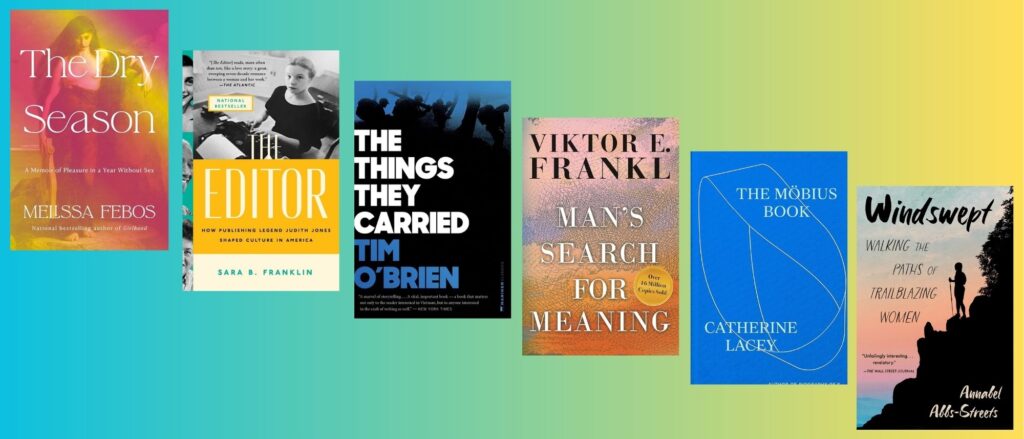
The MöbiusBook by Catherine Lacey
“Only one half of this book is nonfiction, but I still think it’s a revelation of the form. Lacey pairs a devastating breakup memoir (breaking up with a lover, but also breaking up with God) with a novella—without telling her readers which to read first. The book itself is an object that has no clear front or back, and the effect is a marvel of self-storytelling that interrogates the boundaries between the real and the imagined in ways that sometimes dissolve them completely. ‘There’s nothing wrong with inventing a story to explain something real to yourself,’ one woman says to another in Lacey’s text, and the project as a whole explores how we rely on narrative to make sense of our experience. Elsewhere I wrote that ‘for those of us who’ve lost faith in fiction at some point in our lives as writers or readers, Lacey’s highwire act of juxtaposition in The MöbiusBook serves to rekindle our conviction in the value of its ability to reveal rather than to obscure the mysteries of human life.’ I’m not advocating for reading fiction as veiled autobiography or in searching for clues in a novel that might reveal something about its author, but every memoir also necessarily adopts a form and structure distinct from that of lived experience, and Lacey carefully demonstrates how much we construct to reveal what is true.”
– true contributor Richard Larson
The Things They Carried by Tim O’Brien
“I think everyone should read this at least once in their lifetime. A memoir of O’Brien’s time as a soldier during the Vietnam War, the book absolutely floored me. The multifaceted depth of his perspective coupled with the emotion and skill of his writing forces the reader to confront both the ugly and beautiful aspects of war. O’Brien uses stories to tell the emotional truths of his experience with war and leaves no detail sugarcoated; it’s a heavy read, but one that I think all civilians have a responsibility to take the time to consider. I read this book while my dad, a Marine Corps veteran, simultaneously listened to it. I am forever grateful for the understanding that O’Brien’s writing provided and the conversations it opened between my dad and I.”
– true contributor Abby Conrad
Windswept: Walking the Paths of Trailblazing Women by Annabel Abbs
“Recovering from a fall and resultant head injury, Annabel Abbs made a pledge: all holidays would now be walking holidays with her husband and young children. But in preparing for these journeys, Abbs realized all the walking histories she’s found were by and about men. Windswept: Walking the Paths of Trailblazing Women fills this gap by following the steps of women writers and artists like Georgia O’Keeffe, Nan Shepherd, and Simon de Beauvoir to explore how walking inspired their accomplishments. Blending diaries, letters, and interviews with Abbs’s own story, this lyrical book offers new insights into the lives and landscapes of creative women, while inspiring readers to take their own windswept walks.” – true contributor Kayann Short